Earlier this year, I wrote a post about the stupid anti-abortion arguments about how the world could have lost some influential figure had they been aborted. One of the big problems with such arguments is that there's no clear reason why these can't be applied beyond just the topic of abortion and also apply to getting pregnant in the first place. How many influential figures would we have lost had their parents not had sex? Well, now we have a video that includes the sad story of Oliver who wasn't born because his parents didn't have sex (starting at the 0:21 mark).
(Via Friendly Atheist)

Sunday, October 27, 2013

Tuesday, October 22, 2013
Logical Fallacies - A fallacious argument does not make the conclusion false.
This post is used for reference to my breakdown of the book "I Don't Have Enough Faith to Be an Atheist." Related posts can be found by clicking here.
One thing that I need to make clear is that, when I point out a logical fallacy, it does not mean the conclusion is necessarily false. Looking at my various breakdowns of the book IDHEF, I have pointed out numerous strawmen or arguments from ignorance in their "proofs" for god. The fact that these arguments for god are fallacious does not then mean that there is no god. There could be a god but that these are just bad argument. The key point is that there is no reason for me to believe there is a god via such arguments. Essentially, seeing a fallacious arguments can at best lead to the statement, "Your argument is fallacious, therefore I cannot accept your conclusion as true." It does not lead to the statement, "Your argument is fallacious, therefore your conclusion is wrong." Such a statement is itself a logical fallacy known as the "fallacy fallacy."
I bring this up because I have started to get annoyed with the authors' "Roadrunner tactic" that was introduced in Chapter 1. This tactic is occasionally committing the fallacy fallacy when it is used to essentially dismisses any claim out-of-hand due to some perceived flaw in the argument. Worst of all, sometimes the flaw is not in the argument itself, but in a shorthand of the argument. In Chapter 7, they point out that saying "One must never say 'never'" (p173) is flawed because it involves saying "never." Twice, actually! But "never say 'never'" is really just catchy phrasing to make a concept easier to remember — a concept that is saying it is unwise to say "never" because it is impossible to truly know that something can never happen. (Or for whatever reason one might say "never.") To know this would require absolute knowledge, and I would think the authors of IDHEF would agree that humans have no such knowledge based on statements made in Chapter 2. So for them to blindly dismiss this concept because they don't like the phrasing is borderline absurd.
It's one thing to point out argumentative flaws. I'm fine with that as I've done so myself. But concluding that a person is false due to bad arguments is incorrect. This started happening a lot in Chapter 7. Essentially, they point out people making bad arguments for a relativistic morality and conclude that morality cannot be relativistic because of these bad arguments. Sorry, but the best conclusion that can be made when exposing a bad argument is that the argument was bad.
One thing that I need to make clear is that, when I point out a logical fallacy, it does not mean the conclusion is necessarily false. Looking at my various breakdowns of the book IDHEF, I have pointed out numerous strawmen or arguments from ignorance in their "proofs" for god. The fact that these arguments for god are fallacious does not then mean that there is no god. There could be a god but that these are just bad argument. The key point is that there is no reason for me to believe there is a god via such arguments. Essentially, seeing a fallacious arguments can at best lead to the statement, "Your argument is fallacious, therefore I cannot accept your conclusion as true." It does not lead to the statement, "Your argument is fallacious, therefore your conclusion is wrong." Such a statement is itself a logical fallacy known as the "fallacy fallacy."
I bring this up because I have started to get annoyed with the authors' "Roadrunner tactic" that was introduced in Chapter 1. This tactic is occasionally committing the fallacy fallacy when it is used to essentially dismisses any claim out-of-hand due to some perceived flaw in the argument. Worst of all, sometimes the flaw is not in the argument itself, but in a shorthand of the argument. In Chapter 7, they point out that saying "One must never say 'never'" (p173) is flawed because it involves saying "never." Twice, actually! But "never say 'never'" is really just catchy phrasing to make a concept easier to remember — a concept that is saying it is unwise to say "never" because it is impossible to truly know that something can never happen. (Or for whatever reason one might say "never.") To know this would require absolute knowledge, and I would think the authors of IDHEF would agree that humans have no such knowledge based on statements made in Chapter 2. So for them to blindly dismiss this concept because they don't like the phrasing is borderline absurd.
It's one thing to point out argumentative flaws. I'm fine with that as I've done so myself. But concluding that a person is false due to bad arguments is incorrect. This started happening a lot in Chapter 7. Essentially, they point out people making bad arguments for a relativistic morality and conclude that morality cannot be relativistic because of these bad arguments. Sorry, but the best conclusion that can be made when exposing a bad argument is that the argument was bad.
Monday, October 7, 2013
If you'd been paying attention, you'd have known the shutdown was going to happen
I'm a little behind on posting this, but I must say I was just a bit bothered by a comment that was apparently left on the Facebook page of a local news station. The comment was in regards to a question about what concerns people had about the potential government shutdown (as this was on the Monday morning prior). The comment was read on-air and said something about how a deal had been reached last minute the last few times, so they were sure the same was going to happen this time.
To me, it was obvious that either this person wasn't paying close attention or that they don't have a good understanding of the state of politics in this country. It should have been obvious to just about anyone paying the slightest attention by Monday morning that the shutdown was going to happen as there weren't even talks about having negotiations! So how could a last minute deal even be made if no one was trying to reach a deal. That would seem to be a crucial prerequisite.
I would also say that events like Ted Cruz's fake filibusterer should have been a good clue that this was really going to happen this time. Then again, as Rachel Maddow discussed on her show last week Monday, many Republicans campaigned back in 2010 on the idea of shutting down government.
To me, it was obvious that either this person wasn't paying close attention or that they don't have a good understanding of the state of politics in this country. It should have been obvious to just about anyone paying the slightest attention by Monday morning that the shutdown was going to happen as there weren't even talks about having negotiations! So how could a last minute deal even be made if no one was trying to reach a deal. That would seem to be a crucial prerequisite.
I would also say that events like Ted Cruz's fake filibusterer should have been a good clue that this was really going to happen this time. Then again, as Rachel Maddow discussed on her show last week Monday, many Republicans campaigned back in 2010 on the idea of shutting down government.
Visit NBCNews.com for breaking news, world news, and news about the economy
So even with Cruz's dog and pony show, nothing really seems too different than two years ago. So what has changed? I'd suggest that Republicans could back down from a shutdown because they used to have fallbacks. One was the 2012 election where they could potentially gain more negotiating power. Ultimately, they I think they wanted to take back the presidency, but even more control of the Senate was likely in their sights. With more power, they could perhaps get their way while avoiding a shutdown. But they didn't gain power after that election. They actually lost a bit of power. 2014 isn't looking too bright (plus, the presidency isn't an option) and 2016 is too far away. The second was the court system. But that too was lost with last year's decision. (EDIT: Oy! I forgot to mention that this was in reference to the case over the Affordable Care Act.) Now there are no fallbacks that I can see. Shutdown is now the primary option. Hopefully this can be settled before the debt ceiling becomes an issue again!Saturday, September 28, 2013
IDHEF - Chapter 6, Addendum #2: Unobserved Intelligent Design
This is part of my breakdown of the book "I Don't Have Enough Faith to Be an Atheist." Related posts can be found by clicking here.
Throughout my breakdown of Chapter 6, I made note a couple of times of the hypocrisy the authors had in regards to the observation of so-called "macroevolution," while being rather blind to the fact that a designer hasn't been observed. My guess is they would say they have observed the "message" of DNA and that's good enough. But there was more that I missed when I wrote those posts that I only recently considered: Where is the observation of new lifeforms "poofing*" into existence? Or do they believe the lifeforms we see today have always been on earth? Like, do they believe humans lived with dinosaurs? Or did God decide one day a hundred thousands of years ago to take the ape template and tweak it a bit to create humans?
So if God has been deciding to poof new lifeforms into existence every now and then, why haven't we observed this? You could say we haven't been around at the right moment to see this happen, but, I'm sorry, I cannot accept that excuse. They demand that "microevolution" be observed. That excuse of not being around at the right moment can just as easily apply to "macroevolution." If it's not a good excuse for one, then I don't see how it can be applied to the other. What other excuses might there be for why I can't demand some observations of this intelligent designer at work?
* We aren't even given an idea of how this intelligent designer brings new life into the world (which is another major flaw to the idea), so I am left with little choice but to use such a colorful term.
Throughout my breakdown of Chapter 6, I made note a couple of times of the hypocrisy the authors had in regards to the observation of so-called "macroevolution," while being rather blind to the fact that a designer hasn't been observed. My guess is they would say they have observed the "message" of DNA and that's good enough. But there was more that I missed when I wrote those posts that I only recently considered: Where is the observation of new lifeforms "poofing*" into existence? Or do they believe the lifeforms we see today have always been on earth? Like, do they believe humans lived with dinosaurs? Or did God decide one day a hundred thousands of years ago to take the ape template and tweak it a bit to create humans?
So if God has been deciding to poof new lifeforms into existence every now and then, why haven't we observed this? You could say we haven't been around at the right moment to see this happen, but, I'm sorry, I cannot accept that excuse. They demand that "microevolution" be observed. That excuse of not being around at the right moment can just as easily apply to "macroevolution." If it's not a good excuse for one, then I don't see how it can be applied to the other. What other excuses might there be for why I can't demand some observations of this intelligent designer at work?
* We aren't even given an idea of how this intelligent designer brings new life into the world (which is another major flaw to the idea), so I am left with little choice but to use such a colorful term.
Thursday, September 19, 2013
IDHEF - Chapter 6, Addendum #1: Teach the Controversy!
This is part of my breakdown of the book "I Don't Have Enough Faith to Be an Atheist." Related posts can be found by clicking here.
Chapter 6 of the book ended with a spiel for teaching the "controversy." My remarks on the topic started to get to long to fit in with the rest of my break-down of the chapter, so I've created this post just for this topic. Let's do this!
Where I wish to begin is with the large list of things the authors ask "what would be unconstitutional about..." and out of that list what really stuck out in my mind was this "forensic and empirical science" bit. Well, there wouldn't be anything unconstitutional about it; the more relevant question is why would we teach children about a form of science (forensic) that does not exist in the form the authors describe? Here is what Wikipedia has to say about "forensic science":
The next part that stuck out were these back-to-back statements where they now make an appeal to an important skill set: "Why don't we give our children all the scientific evidence—pro and con—and let them make up their own minds? After all, shouldn't we be teaching them how to think critically on their own?" (p167). I totally agree — we should be teaching children how to think critically! The problem is how does "giving our children all the scientific evidence" accomplish this? I could give a child all the scientific evidence available in the world, but how does that teach them how to evaluate that evidence? How does that help them learn what constitutes as high quality evidence versus low quality evidence? The first part** of the trick here, as I see it, is that by presenting multiple ideas, children will have to put some thought into it. But they don't have to put critical thought into it. Thinking and critical thinking are two different processes. (Otherwise, what's the point of having this term "critical thinking"? Why not just call it "thinking" if there is nothing different about it?) The second part of the trick is semantics and involves getting people to believe that if one engages in criticizing something they are thus engaging in critical thinking. This is not what "critical thinking" is. Critical thinking is more specific than this; as Wikipedia states, "'Critical' as used in the expression 'critical thinking' connotes involving skillful judgment as to truth, merit, etc. 'Critical' in this context does not mean 'disapproval' or 'negative.'" Putting the two parts together, I see the appeal being that giving children information critical toward evolution will make them think about it and since this information is critical (as in "negative toward", not "crucial for"), the thoughts about it will thus be critical. It doesn't work this way. Don't fall for this!
Lastly, I want to address this final statement as well as go back to the statement where they say, "I thought this was science. There must be something else at stake here" (p161-162). The problem is not, as the authors suggest, that we "lack the faith to believe that [our] theory will still be believed after our children see all the evidence" (p167). The problem is more that thinking, whether critically or not, is hard. And thinking critically is even harder! As I've said amongst these last two paragraphs, just giving children evidence does no good if you don't even bother to teach them how to think critically to evaluate the evidence. (And just giving them evidence does not teach them how to think critically.) You could throw all the evidence in the world for any claim — not just evolution — at children and they won't necessarily accept any theory when they have no idea how to understand the evidence.
I may have an analogy for this. You could put a child in the driver's seat of a car, but would you expect them to be able to drive? Especially if they've never seen a car before? If you told them to get in and drive, that would quite literally be an accident waiting to happen! (Once, you know, they figure out how to put it in gear and all.) Back in reality, we start by teaching children how to drive before actually allowing them to drive. And even then we slowly work on their skills, such as having them drive in empty parking lots before even thinking about letting them go out on the road. The same approach should be used toward critical thinking skills. You need to first teach children how critical thinking skills work. Then you give them simple exercises to develop those skills. Later on you could then give them all this evidence after sufficient critical thinking skills have developed. But you don't give them a bunch of evidence and expect them to develop critical thinking skills from that. This is — figuratively this time — an accident waiting to happen!
What kind of accident would I suspect? This gets us back to how thinking is hard. When children don't have the critical thinking skill set to evaluate evidence, what they'll likely do is choose the idea that is easier to think about, regardless of evidence. Which is easier to think about? One: God said, "Let there be life!" and there was? Or two: Life gained complexity and diversity through millions of generations of reproduction with the environment putting pressures on the organisms so that those that were the most fit for their environment had the greatest chance to reproduce***...? When you have no idea how to evaluate evidence, I'd expect most people to pick the first one. And if both options are presented as being equally likely (or with equal weight)? Well, let me just finish by saying lack of faith in the theory isn't the problem; lack of faith in human intelligence is.
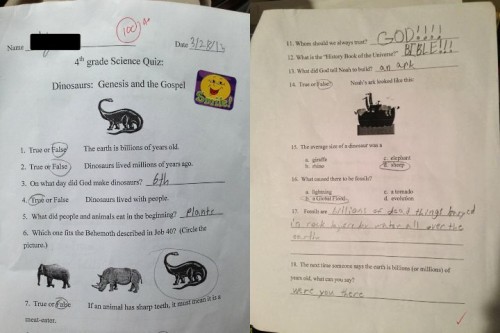
It also doesn't help that there is a lot of arguments to wade through! No one without good critical thinking skills would be able to get through it all. Let's take the example of flightless birds to the claim that transitional forms are not viable. This should be an easy point to recognize, even without good critical thinking skills. So of course creationists have a response! It actually surprises me a bit that there was no such response in the book. On this note, I must be forthright and point out that I cannot claim that this particular response would match the response the authors of the book would give. But I would not suspect it to really be much different, either. I'll be adding comments in purple in the blockquote. This picture above (you should be able to click to enlargen) is what many of these Christians actually want to teach children. This is from a private school in South Carolina where this sort of teaching is allowed since the U.S. Constitution does not apply to such schools. This is not about providing children will all the evidence or "exposing the problems with macroevolution" (p167). This is about keeping them locked in to a biblical worldview where they learn poor reasoning skills. Just look at what the "correct" answer is to #18. Do you see a problem with this? How, then, can this girl answer a number of the other questions? Was she there? This is what people such as myself are concerned about. I'm concerned for the future of the children that go to such schools. They are, as the cliche goes, the future. I fear teaching more children this sort of material could lead to a very bleak future.
* Actually, I wonder if that may be helpful. Might people reading this book today catch on that forensic science isn't what these authors claim? Realize, CSI debuted in 2000, only about 4 years before this book came out. Though, that should have been enough time for these authors to adapt their argument and change the name so that people would be less likely to pick up on the fact that they are making up forms of science.
** I find it somewhat amusing that these attempts to trick people into supporting intelligent design based on promoting critical thinking require people to lack critical thinking skills in order to work.
*** That's my attempt to put evolution in a nutshell. I make no claims that I did a very successful job in doing so! :)
I also want to give a quick mention to a twist in this "critical thinking" sales pitch. This is from current events down in Texas where science textbooks are under review. One of the reviewers wrote a letter discussing his(?) experiences (emphasis mine):
Chapter 6 of the book ended with a spiel for teaching the "controversy." My remarks on the topic started to get to long to fit in with the rest of my break-down of the chapter, so I've created this post just for this topic. Let's do this!
Where I wish to begin is with the large list of things the authors ask "what would be unconstitutional about..." and out of that list what really stuck out in my mind was this "forensic and empirical science" bit. Well, there wouldn't be anything unconstitutional about it; the more relevant question is why would we teach children about a form of science (forensic) that does not exist in the form the authors describe? Here is what Wikipedia has to say about "forensic science":
Forensic science...is the application of a broad spectrum of sciences and technologies to investigate and establish facts of interest in relation to criminal or civil law.Did you catch that part about it being "a broad spectrum of sciences"? These authors describe forensic science as being its own unique field. It's not. And, as I've said earlier on this chapter on the subject, what they describe isn't even science. I'll repeat that what seems to be going on here is that they are trying to use the "authority" (for lack of better word) of science — because it works and has helped to produce awesome technology like the electronic device on which you the reader are viewing this post — to make their ideas appear more legit. That and they can't argue their ideas should be taught in science classes, as they do here, if they can't get people to believe that these ideas are even scientific in the first place! Sadly, as many Americans are scientifically illiterate, many might not really know what forensic science is beyond what they see on TV with all of the CSI* shows.
The next part that stuck out were these back-to-back statements where they now make an appeal to an important skill set: "Why don't we give our children all the scientific evidence—pro and con—and let them make up their own minds? After all, shouldn't we be teaching them how to think critically on their own?" (p167). I totally agree — we should be teaching children how to think critically! The problem is how does "giving our children all the scientific evidence" accomplish this? I could give a child all the scientific evidence available in the world, but how does that teach them how to evaluate that evidence? How does that help them learn what constitutes as high quality evidence versus low quality evidence? The first part** of the trick here, as I see it, is that by presenting multiple ideas, children will have to put some thought into it. But they don't have to put critical thought into it. Thinking and critical thinking are two different processes. (Otherwise, what's the point of having this term "critical thinking"? Why not just call it "thinking" if there is nothing different about it?) The second part of the trick is semantics and involves getting people to believe that if one engages in criticizing something they are thus engaging in critical thinking. This is not what "critical thinking" is. Critical thinking is more specific than this; as Wikipedia states, "'Critical' as used in the expression 'critical thinking' connotes involving skillful judgment as to truth, merit, etc. 'Critical' in this context does not mean 'disapproval' or 'negative.'" Putting the two parts together, I see the appeal being that giving children information critical toward evolution will make them think about it and since this information is critical (as in "negative toward", not "crucial for"), the thoughts about it will thus be critical. It doesn't work this way. Don't fall for this!
Lastly, I want to address this final statement as well as go back to the statement where they say, "I thought this was science. There must be something else at stake here" (p161-162). The problem is not, as the authors suggest, that we "lack the faith to believe that [our] theory will still be believed after our children see all the evidence" (p167). The problem is more that thinking, whether critically or not, is hard. And thinking critically is even harder! As I've said amongst these last two paragraphs, just giving children evidence does no good if you don't even bother to teach them how to think critically to evaluate the evidence. (And just giving them evidence does not teach them how to think critically.) You could throw all the evidence in the world for any claim — not just evolution — at children and they won't necessarily accept any theory when they have no idea how to understand the evidence.
I may have an analogy for this. You could put a child in the driver's seat of a car, but would you expect them to be able to drive? Especially if they've never seen a car before? If you told them to get in and drive, that would quite literally be an accident waiting to happen! (Once, you know, they figure out how to put it in gear and all.) Back in reality, we start by teaching children how to drive before actually allowing them to drive. And even then we slowly work on their skills, such as having them drive in empty parking lots before even thinking about letting them go out on the road. The same approach should be used toward critical thinking skills. You need to first teach children how critical thinking skills work. Then you give them simple exercises to develop those skills. Later on you could then give them all this evidence after sufficient critical thinking skills have developed. But you don't give them a bunch of evidence and expect them to develop critical thinking skills from that. This is — figuratively this time — an accident waiting to happen!
What kind of accident would I suspect? This gets us back to how thinking is hard. When children don't have the critical thinking skill set to evaluate evidence, what they'll likely do is choose the idea that is easier to think about, regardless of evidence. Which is easier to think about? One: God said, "Let there be life!" and there was? Or two: Life gained complexity and diversity through millions of generations of reproduction with the environment putting pressures on the organisms so that those that were the most fit for their environment had the greatest chance to reproduce***...? When you have no idea how to evaluate evidence, I'd expect most people to pick the first one. And if both options are presented as being equally likely (or with equal weight)? Well, let me just finish by saying lack of faith in the theory isn't the problem; lack of faith in human intelligence is.
It also doesn't help that there is a lot of arguments to wade through! No one without good critical thinking skills would be able to get through it all. Let's take the example of flightless birds to the claim that transitional forms are not viable. This should be an easy point to recognize, even without good critical thinking skills. So of course creationists have a response! It actually surprises me a bit that there was no such response in the book. On this note, I must be forthright and point out that I cannot claim that this particular response would match the response the authors of the book would give. But I would not suspect it to really be much different, either. I'll be adding comments in purple in the blockquote.
There are at least two possibilities as to why flightless birds such as ostriches and emus have wings, either:So what starts as a simple rebuttal leads to another rebuttal and then to another rebuttal, and so on. We really expect children to just be able to figure this out and to develop critical thinking skills if we just throw all of this at them? And then there's this:
- The wings are indeed “useless” and derived from birds that once could fly. This is possible in the creationist model. [Well, sure, anything is possible in the creationist model, as discussed in my part II breakdown of Chapter 6. But if creationists want their model to be taken seriously, it really needs to be able to reasonably explain this instead of merely stating the obvious.] Loss of features is relatively easy by natural processes, whereas acquisition of new characters, requiring specific new DNA information, is impossible. [Would someone without good critical thinking skills (assuming they have all the evidence) pick up on the fact that this has been empirically tested to be possible? This then gets us into the next creationist responses, which will look something like, "Those fruit flies are still fruit flies" or "Those bacteria are still bacteria" depending on what experiment is mentioned. Would someone without good critical thinking skills recognize that this is a logical fallacy known as "moving/shifting the goal posts"? (The original goal post was just simply adding "information" — whatever that exactly means — to becoming a demand that offspring be part of a different classification.)] Loss of wings most probably occurred in a beetle [What??? We were talking about birds. What do beetles have to do with this?!?] species that colonized a windy island. Again, this is a loss of genetic information, so it is not evidence for microbe-to-man evolution, which requires masses of new genetic information.[1]
- The wings have a function. Some possible functions, depending on the species of flightless bird, are: balance while running, cooling in hot weather, warmth in cold weather, protection of the ribcage during falls, mating rituals, scaring predators (emus will run at perceived enemies of their chicks, mouth open and wings flapping), sheltering of chicks, etc. [And yet, none of these reasons seem to be considered for why an animal would develop wings without the ability to fly in the first place!] If the wings are useless, why are the muscles functional, allowing these birds to move their wings?
* Actually, I wonder if that may be helpful. Might people reading this book today catch on that forensic science isn't what these authors claim? Realize, CSI debuted in 2000, only about 4 years before this book came out. Though, that should have been enough time for these authors to adapt their argument and change the name so that people would be less likely to pick up on the fact that they are making up forms of science.
** I find it somewhat amusing that these attempts to trick people into supporting intelligent design based on promoting critical thinking require people to lack critical thinking skills in order to work.
*** That's my attempt to put evolution in a nutshell. I make no claims that I did a very successful job in doing so! :)
I also want to give a quick mention to a twist in this "critical thinking" sales pitch. This is from current events down in Texas where science textbooks are under review. One of the reviewers wrote a letter discussing his(?) experiences (emphasis mine):
in the review of the HoughtonMifflin Harcourt textbook, an incredible resource, a panel member comments:I understand the National Academy of Science's strong support of the theory of evolution. At thesame time, this is a theory. As an educator and parent, I feel very strongly that "creationscience" based on Biblical principles should be incorporated to every Biology book that is up foradoption. It is very important for students to use critical thinking skills and give them theopportunity to weigh the evidence between evolution and "creation science."At least in this case the creationist isn't suggesting the ridiculous claim that this will teach critical thinking skills. The problem is assuming that students have such skills. I don't know of many schools that teach such skills, which is unfortunate, and I'd be highly surprised if such classes would be promoted in Texas, especially since their original 2012 Republican party platform rejected critical thinking skills.
Tuesday, September 17, 2013
IDHEF - Chapter 6: New Life Forms: From the Goo to You via the Zoo? (Part II)
This is part of my breakdown of the book "I Don't Have Enough Faith to Be an Atheist." Related posts can be found by clicking here.
Part II
IS INTELLIGENT DESIGN AN INTELLIGENT ALTERNATIVE?
Objection: Intelligent Design is not science.
This section is a bit ironic. In the first paragraph, the authors state "The Darwinists' claim that intelligent design is not science is based on their biased definition of science" (p156). Supposedly, this definition does not allow for intelligent causes. I'll say that's bullocks, but the more interesting thing is that these authors themselves seem to be defining science as merely an attempt to answer questions. That is a very unsophisticated view on science. Yes, science can be defined merely as "the state of knowing," but in this context, a better definition (with the key part highlighted) is "knowledge or a system of knowledge covering general truths or the operation of general laws especially as obtained and tested through scientific method." The definition of the scientific method, then is as follows:principles and procedures for the systematic pursuit of knowledge involving the recognition and formulation of a problem, the collection of data through observation and experiment, and the formulation and testing of hypothesesThis goes right back to things I said in regards to earlier parts of this chapter, which essentially was, "Where are the tests???" Getting back to the irony, though, these authors imply — they couldn't even be bothered to provide a definition of science — a very flexible definition of science after accusing "Darwinists" of using a biased definition. Pot, meet kettle.
Tuesday, September 10, 2013
Know thine enemy. And their arguments.
I, as I would think many liberals do, get irritated when conservatives accuse us of believing X, Y, and Z when we don't. Likewise, I get a bit irritated when liberals accuse those who are more conservative of believing things they don't actually believe. Such often seems to be the case with liberal Christians misrepresenting the beliefs of the more conservative Christians. Below is a clip of Australian Prime Minister Kevin Rudd addressing a pastor in what is apparently a Q&A session. I'm embedding the video from The Last Word as that is where I first saw the actual video (I had read about it earlier at Pharyngula). Lawrence O'Donnell finds the response "brilliant." From a political perspective, yeah, he's been getting good press from what I've seen, so it's probably working out for him. But from a perspective of making a good argument, it is not impressive. I'll go more into Rudd's remarks from the video below the fold. First, I'll address how they misrepresent his opponents position. Then further below I'll cover other problems with his remarks. (The clip I'm interested in starts around 40 seconds in if you'd like to skip ahead.)
Visit NBCNews.com for breaking news, world news, and news about the economy
Subscribe to:
Comments (Atom)