On a recent Saturday, some Jehovah's Witnesses came by my house and the discussion I had seemed rather odd. For starters, it looked like at least four people came, but two people just sat in the vehicle they came in the entire time. I didn't ask about that, so perhaps they were just rotating? I've gone door-to-door for political canvasing; it's not something I find enjoyable, so I could see taking a break if I were with a larger group.
As for the two people I did talk with, Cliff and Joanne (I believe were their names), Cliff did most of the talking. And I wouldn't call what he did much more than talk. He never really made a case for anything he was saying. Rather, his talking-points were the types of points that may cause people to cave into their ignorance. Basically, he was asking questions about how something may have came to be, with the idea being that, because I don't have an answer, I should then assume a god is responsible. I'm wiser than that, so his talking points did not move me at all.
For some examples, the very first "point" he tried to make related to this idea that the Bible is still a best-seller, despite all the attacks that have been made against it. He asked if I thought something might be behind this. The idea here is that there is supposedly no way the Bible could have survived through history if it was not, at the very least, divinely inspired. (Some may go further and claim that a god has been protecting the Bible.) Next he went to verses in Revelation about Armageddon. He was suggesting that the verse was talking about our present day and asked how the author could have known this was going to happen. For kicks, here are the two verses, Revelation 16:13-14: "Then I saw three impure spirits that looked like frogs; they came out of the mouth of the dragon, out of the mouth of the beast and out of the mouth of the false prophet. They are demonic spirits that perform signs, and they go out to the kings of the whole world, to gather them for the battle on the great day of God Almighty." Your guess is probably as good as mine as to how that is supposed to relate to the present day.
Other talking-points he raised related to biology and cosmology. I can't even remember the stupid questions he asked, but what he was going for was trying to get me to think that there is no way the world could have come about naturally and, therefore, I should believe a supernatural being is responsible. I, of course, understand how bogus such thinking is and did not cave in.
This may have made the conversation weird. I wonder if I threw him off by not accepting his sales pitches, which left him struggling to decide which pitch to go to next. That said, I doubt he actually had any sort of argument and that's what I'm really interested in. This is where I failed in the conversation. If he wasn't going to present an argument by himself, I should have found a way to request that he present one. Also, there was one point where he asked if I believe everything I was taught in school. He, to little surprise, was out to get me to doubt the teachings of evolution. This was an opportunity for me to ask him how he goes about determining what is true and what is not. What is his methodology? Why should anyone believe that his methodology is actually reliable? I wonder if he actually had any methodology. If there is a next time, I'll have to do a better job on this.

Showing posts with label Ignorance. Show all posts
Showing posts with label Ignorance. Show all posts
Tuesday, August 9, 2016

Tuesday, August 21, 2012
A few thoughts on Akin
Everyone and their dog is discussing Akin...so I'm not sure what I can add of value to the conversation, but there are a few thoughts I want to share:
 It is crap to say that Akin "misspoke." He meant what he said and said what he meant! The only reason he "misspoke" is because what he said has become politically damaging. So he wants to take it back like it never happened.
UPDATE: A source from 1999 has been revealed by far-right loon Bryan Fischer as to where this idea may originate. /UPDATE
* OK, I can't read minds, so I can't be certain that Republicans are lying when they condemn Akin. But given the point above about how they have a reputation of making quite similar comments, this change of heart seem quite odd...and quite convenient.
This isn't new.
First, many conservatives have been frequently saying similar things within the last year. Second, they have a history of making similar remarks. In fact, I recall a moment from high school (so over 10 years ago) of a classmate saying that a woman can't get pregnant unless they enjoy it, so any woman who claimed to be raped that ended up pregnant was proof they enjoyed being raped. While I don't recall if he said it directly, there was certainly the implication that such a rape wasn't a "real" rape. (I wonder what these people think about date rape drugs.) Being that this was high school, I figure he would not have come to this conclusion on his own. It would be more likely that he was parroting something he heard from somebody else without giving it much critical thought.He didn't "misspeak."
UPDATE: A source from 1999 has been revealed by far-right loon Bryan Fischer as to where this idea may originate. /UPDATE
This isn't even that radical per our culture.
I'm going to be blunt: we live in a culture that is not hostile to rape. In fact, there is often a lot of victim blaming. If a woman claims she was raped, people go about asking if she was drinking, what she was wearing, and where she was when or immediately before the rape occurred. Because, see, if she was drunk, wearing revealing clothing, and/or hanging out in a frat house or bar, she totally got what was coming to her. It's like she was begging for it to happen! Filthy SLUT! Or so our culture tends to claim. So if women are responsible for their own rapes, then it only seems to be a small step to add on the additional claim that many women enjoy being raped.So why the outrage?
This puzzles me a bit. Our culture isn't that hostile to rape, yet, such a comment gets a lot of bad reaction. I suspect there may be some sort of doublethink going on here, where most people are opposed to rape in theory, but this opposition fails to translate in practice. Since Todd Akin was discussing rape in theory, his comments are then on the fringes of society. I also suspect that his use of the word "legitimate" had some effect on people's reactions.How is this different than "forced rape"?
Conservatives, in an effort to limit rape exceptions to bans on federal funding for abortion, tried to use the term "forced rape." How does "forced rape" differ from just plain old "rape"? I'm not sure, but people have been wondering if plain old rape isn't "legitimate."An unpopular issue. So Akin has got to go.
While what Akin said isn't much different than what conservatives have been pushing for years, more attention has been paid to their language...I would say particularly since March when contraception became an issue. Republicans have since not been very popular with women, an issue they have been trying to since correct. Not by changing their stances on the issues, of course! But by staying on the down-low, hoping people will forget by November. But Akin had to open his mouth and stir up a hornet's nest. So Republicans are condemning what Akin has said and asking him to drop out of his Senate race. All the while likely* still agreeing with what Akin said.* OK, I can't read minds, so I can't be certain that Republicans are lying when they condemn Akin. But given the point above about how they have a reputation of making quite similar comments, this change of heart seem quite odd...and quite convenient.
Wednesday, May 30, 2012
"I'm again' it!"
A few weeks back when there was that win for bigotry in North Carolina, I saw on a comment board somewhere of this argument bigots think is clever about putting gays and lesbians on an island and showing that they'll eventually die out because they can't reproduce. That particular argument is stupid because (1) actually they often can reproduce, so if you put men and women together, even if goes against their sexual preference, they'd probably work it out to reproduce. And (2) why is this relevant? There seems to be two routes this argument is supposed to take: (1) This is supposed to show that homosexuality is "unnatural" and therefore should be condemned and, if that argument doesn't impress, (2) gay people should not be allowed to marry because they can't have children. The argument is horribly flawed. It's an appeal to nature, which is a fallacious argument and can be seen more clearly when the same argument can be made for people who are infertile or people who are intersex*, like my wife. Are these people "unnatural"? Should they not be allowed to be married? What about adoption? And since when was marriage primarily about procreation?
This last question is something that I feel was addressed adequately at Alethian Worldview.
And, finally, there is the pastor in the video below who inspired the title of this post. He's still essentially trying to make the same argument. Except that he seems to think that homosexuals are never born from heterosexuals. So he's got to separate the men from the women to ensure they don't reproduce for the sake of reproduction. Once again, the same argument can be applied to people who are intersex or infertile. So to limit the rights of one of these groups and not the others is discriminatory, plain and simple.
* I was discussing recently with Amy that it surprises me that the topic of intersex people does not come up seemingly at all in the discussion of gay rights, especially as a counter to these naturalistic arguments. I suppose intersex people are more rare than homosexuals and, from my experience, it seems intersex people tend to not talk much about their condition, leading to people being unaware that they know an intersex person. So this could create an "out of sight, out of mind" problem.
This last question is something that I feel was addressed adequately at Alethian Worldview.
...In the first place, unless adoption or premarital sex is involved, there’s going to be at least some portion of the marriage in which there are no children present to be raised. And then they grow up and leave home, so they’re not part of the child-rearing environment anyway. So does the couple still have a marriage? ... Again, you’ve got a definition of marriage that tries to divert attention away from the relationship between the people getting married, and onto some contrived and disingenuous criterion intended to deny equal rights to a certain segment of society. Bad definition.That last bit is for those who want to "define" marriage. Interestingly (not really), their reasons for marriage being between a man and a women end up redefining their own definition. That's how bad the argument is. Still, I get quite insulted by these people who suggest marriage is about raising children. What about love? And the argument encounters other problems: Besides people who are intersex or infertile, what about elderly people who marry past their child-bearing years? (Well, I guess that technically makes them infertile, but most people probably don't view it that way.) And, more disturbing, what about teenagers? Is it OK for them to get married as soon as they can start reproducing? Why not? Remember, any reason given for this must be applied to everyone.
(snip)
...And did you notice? Changing the definition of marriage so that it refers primarily to child-rearing is, ta-da, changing the definition of marriage...
And, finally, there is the pastor in the video below who inspired the title of this post. He's still essentially trying to make the same argument. Except that he seems to think that homosexuals are never born from heterosexuals. So he's got to separate the men from the women to ensure they don't reproduce for the sake of reproduction. Once again, the same argument can be applied to people who are intersex or infertile. So to limit the rights of one of these groups and not the others is discriminatory, plain and simple.
* I was discussing recently with Amy that it surprises me that the topic of intersex people does not come up seemingly at all in the discussion of gay rights, especially as a counter to these naturalistic arguments. I suppose intersex people are more rare than homosexuals and, from my experience, it seems intersex people tend to not talk much about their condition, leading to people being unaware that they know an intersex person. So this could create an "out of sight, out of mind" problem.
Tuesday, October 25, 2011
Radical!!! (a.k.a. Extremist!!!) - Part 1
This is looking to become a 5-part series. Links will be added as the posts become available. Part 2 Part 3 Part 4 Part 5
This is a post that pains me a bit to write. Being insulted can be disappointing as it is, but when that insult is out of ignorance, it adds another level of disappointment. It has to do with being called a radical. It is typically meant as an insult, but the most disappointing part is that people don't seem to fully understand what the word means.
So, let's first start by learning the definition of the word. In typical usage, the word "radical" means "One who advocates fundamental or revolutionary changes in current practices, conditions, or institutions."
Now that you have the definition, please ask yourself...
On a side note, here's a good one that reveals that people want change, but fear getting involved: "I agree with most of your objectives, but you just go too far for me." Doesn't that actually seem like a good reason to get involved with the group and then use your influence in the group to scale things back to your level of comfort?

Adam Lee of Daylight Atheism has an excelent post on what he calls the "golden mean." His post is more directed toward the media for often seeking the middle ground on issues, but it's much about the extremists (radicals) being ignored, including those American Revolutionaries, which is also applicable to the general public.
Now, some of you who are reading to this may object to the idea that Martin Luther King Jr, Susan B. Anthony, etc. were radicals. Well, they wouldn't be from today's standards. That's because they were successful in changing the status quo. They shifted the ideas of society to where their radical ideas became the norm. So when I say that these people were radicals, you must put their ideas in the context of the time in which they lived, not in today's world.
And now to the reason why I write this post: I have been called a radical/extremist as of late. I suppose it's true. Go ahead and call me a radical/extremist if you mean it sincerely. But all the people I've heard call me that don't. They are out instead to either degrade me or to mock me. When you look at history, radicals have almost, if not, always been an important part of progress. Do some radicals work against progress? Sure, but to automatically discount someone for being a radical is ignorant of history at best.
There was another nerve that was struck with that friend's post. The weekend after this post, I got to know the girlfriend of a friend a bit better. So let me first add the disclaimer that I do not know this woman that well, so maybe I'm just getting a bad impression from what little was said. Continuing, she said a couple things, when paired together, don't necessarily go together. The topic got to be about Planned Parenthood/abortion/birth control, in which she was very stern in a statement that "there is nothing wrong with birth control!" but then said something about there being "extremists on both sides," with the implication being that she is not one of those extremists. That puzzled me. Not the part that there are "extremists on both sides," but rather what does she think the extremists on the one side think? I'm quite sure I listen to those extremists and could perhaps be considered one myself, and I can tell you that "there is nothing wrong with birth control!" is very much like something you will here the extremists say2. So where does she differ from the extremists? And here I'll go back to my disclaimer because I honestly do not know her well enough to determine that. (Extremists also advocate for the usage of birth control. Is she against that? Or is it the mandate that insurance cover birth control?) Still, I had the feeling that she at least has some extremist views, but doesn't want to see herself as one of them.
2 People from my generation who read this may think I'm out of my mind for suggesting that the opinion that nothing is wrong with birth control is a radical position. Guess what? You were raised in a society that had been changed by (guess who?) radicals of the feminist movement. Older generations still alive today may have a different opinion on the matter. (In general, that is. There are bound to be members of that generation that are fine with the use of birth control. And perhaps even more who are hypocritical about its use.) This is a living example of a shift in the status quo.

That's all for part 1. In part 2, I'll address how there is no such thing as a "radical atheist," at least not in the way often implied. Stay tuned.
1 On a very interesting note, there are some signatures in that olive branch petition you might be surprised to see. Apparently, some of those people changed their opinions in a year's span. Or maybe they signed because the Continental Congress had voted for it?
Supplimentary: Here are some blog posts that have popped up recently that have some similar ideas to mine.
1. Stephanie Zvan on radical feminism
2. Greg Laden on Occupy Wallstreet protestor who might be dismissing the groups that started the protests in the first place (esp. the left-wing nut jobs)! (Unfortunately, we can't know for sure the woman's intent based on the sign alone.)
3. More from Stephanie Zvan. This is relavent in that it discusses how movements are often ruined by those in the middle, not the extremists.
This is a post that pains me a bit to write. Being insulted can be disappointing as it is, but when that insult is out of ignorance, it adds another level of disappointment. It has to do with being called a radical. It is typically meant as an insult, but the most disappointing part is that people don't seem to fully understand what the word means.
So, let's first start by learning the definition of the word. In typical usage, the word "radical" means "One who advocates fundamental or revolutionary changes in current practices, conditions, or institutions."
Now that you have the definition, please ask yourself...
What's so bad about being a radical?
I suspect it's the part about change. Let's face it, most people will show content with the status quo. The status quo brings with it predictability. When things stay the same, you know tomorrow (that's a metaphor for the future, not the literal tomorrow) will be pretty much the same as today. You know how to prepare for tomorrow, because you've already done so numerous times already. Change, however, can be challenging. When you don't know what tomorrow will bring, how do you prepare for tomorrow? The other part about change is that advocating for change takes work. So, even if people are not truly content with the status quo, changing it is decided to not be worth the effort for many. Then, if you are such a person, what might you do to prevent becoming involved in groups that advocate for change? I suggest that the solution many people take is to demonize those groups. Declare them insane and you don't have to get involved. After all, you don't want to be labeled insane yourself, do you? It would seem the word "radical" has had it's meaning twisted for such purposes.On a side note, here's a good one that reveals that people want change, but fear getting involved: "I agree with most of your objectives, but you just go too far for me." Doesn't that actually seem like a good reason to get involved with the group and then use your influence in the group to scale things back to your level of comfort?
Examples of radical behavior
Take a look at that definition for the word "radical" again. Notice any other words that start with an "r" that appear interesting? I'm talking about the word "revolutionary." In fact, the word "revolutionary" is really just a synonym of the word "radical." But isn't being a revolutionary usually viewed in a positive light? (Or have most Americans forgotten what the Fourth of July holiday is about?) How, then, did being a radical become such a negative? Once again, I suggest that it is due to twisting the meaning of the word to diminish social movements that has caused the distinction.Adam Lee of Daylight Atheism has an excelent post on what he calls the "golden mean." His post is more directed toward the media for often seeking the middle ground on issues, but it's much about the extremists (radicals) being ignored, including those American Revolutionaries, which is also applicable to the general public.
When Great Britain's colonies in the New World were struggling with the oppression of a distant, dictatorial ruler and a burdensome tax scheme, who was right - the dangerous, zealous extremists who argued that the colonists should rebel completely against King George and create a completely new republic, or the sober, responsible moderates who felt that we should reconcile with the king, accept his divine authority and just ask him nicely to treat us better?1I think he could have tried to find quotes from some other radicals, like Elizabeth Cady Stanton or Susan B. Anthony, but hopefully you now have an idea of the wicked thoughts of extremists!"Perhaps the sentiments contained in the following pages, are not YET sufficiently fashionable to procure them general favour; a long habit of not thinking a thing WRONG, gives it a superficial appearance of being RIGHT, and raises at first a formidable outcry in defense of custom."When slavery divided the United States and the country was burning on the brink of civil war, who was right - the wild-eyed abolitionist fanatics who thought that slavery should be ended completely and all slaves should be set free, or the cool-headed, wise statesmen who felt that the best compromise was to ensure an equal number of free states and states that permitted the slavery of human beings?
—Thomas Paine, Common Sense, an influential 1776 pamphlet arguing that the American colonies should declare independence"I am aware that many object to the severity of my language; but is there not cause for severity? I will be as harsh as truth, and as uncompromising as justice. On this subject, I do not wish to think, or to speak, or write, with moderation. No! no! Tell a man whose house is on fire to give a moderate alarm; tell him to moderately rescue his wife from the hands of the ravisher; tell the mother to gradually extricate her babe from the fire into which it has fallen; — but urge me not to use moderation in a cause like the present. I am in earnest — I will not equivocate — I will not excuse — I will not retreat a single inch — AND I WILL BE HEARD."When Jim Crow laws and de jure segregation divided American citizens into two classes of people, and people of African descent were fighting for liberty, who was right - the irrational, hysterical partisans like Martin Luther King Jr. who felt that acts of civil disobedience would startle the nation out of its apathy, or the sober, responsible religious leaders who felt that breaking the law, even if done peacefully, was an extreme and irresponsible course of action that would reflect poorly on the entire movement?
—William Lloyd Garrison, inaugural editorial in the anti-slavery journal The Liberator, 1 January 1831"But though I was initially disappointed at being categorized as an extremist, as I continued to think about the matter I gradually gained a measure of satisfaction from the label. Was not Jesus an extremist for love: 'Love your enemies, bless them that curse you, do good to them that hate you, and pray for them which despitefully use you, and persecute you.' Was not Amos an extremist for justice: 'Let justice roll down like waters and righteousness like an ever-flowing stream.' Was not Paul an extremist for the Christian gospel: 'I bear in my body the marks of the Lord Jesus.' Was not Martin Luther an extremist: 'Here I stand; I cannot do otherwise, so help me God.' And John Bunyan: 'I will stay in jail to the end of my days before I make a butchery of my conscience.' And Abraham Lincoln: 'This nation cannot survive half slave and half free.' And Thomas Jefferson: 'We hold these truths to be self-evident, that all men are created equal...' So the question is not whether we will be extremists, but what kind of extremists we be. Will we be extremists for hate or for love? Will we be extremist for the preservation of injustice or for the extension of justice?"
—Martin Luther King Jr., Letter from a Birmingham Jail, 16 April 1963
Let's be real about being radical
That last statement was sarcastic, if you couldn't tell. The point is that there isn't anything automatically bad about being a radical. In fact, we have a holiday celebrating the birthday and life of the radical Martin Luther King Jr. With that, I think the last part of his quote is the important question to be asked about radicals/extremists: "Will we be extremist for the preservation of injustice or for the extension of justice?"Now, some of you who are reading to this may object to the idea that Martin Luther King Jr, Susan B. Anthony, etc. were radicals. Well, they wouldn't be from today's standards. That's because they were successful in changing the status quo. They shifted the ideas of society to where their radical ideas became the norm. So when I say that these people were radicals, you must put their ideas in the context of the time in which they lived, not in today's world.
And now to the reason why I write this post: I have been called a radical/extremist as of late. I suppose it's true. Go ahead and call me a radical/extremist if you mean it sincerely. But all the people I've heard call me that don't. They are out instead to either degrade me or to mock me. When you look at history, radicals have almost, if not, always been an important part of progress. Do some radicals work against progress? Sure, but to automatically discount someone for being a radical is ignorant of history at best.
Shooting yourself in the foot.
I have a friend who posted on Facebook the following:If you don't like something, the only real difference you can make is to take action. You can complain until you're blue in the face & it's only gonna make you feel better for a moment. If you're too meek & submissive or too lazy to fight anything, you have but two other choices: Either sit & stew in your own puke or submit to everything & convince yourself that it's for your own good. Most people end up doing the latter.That struck a (metaphorical) nerve with me. It struck the same nerve that pains me in writting this post. It is the same nerve that has been bothering me in conversations with my father as of late. He is a man who has complained about politics and occasionally religion for as long as I have known him. I used to think that he was a man who would advocate for change if he had better opportunities presented to him (as well as fewer responsibilities with the farm). But now that I'm all grown up and out advocating for change by being outspoken and supporting groups that promote change? I'm "just as radical as the fundamentalist [Christians]." It turns out my father is a "sit & stew in your own puke" type of person. And, as I spoke about earlier, he has also turned out to be one of those people who doesn't want things to change. *Sigh*
There was another nerve that was struck with that friend's post. The weekend after this post, I got to know the girlfriend of a friend a bit better. So let me first add the disclaimer that I do not know this woman that well, so maybe I'm just getting a bad impression from what little was said. Continuing, she said a couple things, when paired together, don't necessarily go together. The topic got to be about Planned Parenthood/abortion/birth control, in which she was very stern in a statement that "there is nothing wrong with birth control!" but then said something about there being "extremists on both sides," with the implication being that she is not one of those extremists. That puzzled me. Not the part that there are "extremists on both sides," but rather what does she think the extremists on the one side think? I'm quite sure I listen to those extremists and could perhaps be considered one myself, and I can tell you that "there is nothing wrong with birth control!" is very much like something you will here the extremists say2. So where does she differ from the extremists? And here I'll go back to my disclaimer because I honestly do not know her well enough to determine that. (Extremists also advocate for the usage of birth control. Is she against that? Or is it the mandate that insurance cover birth control?) Still, I had the feeling that she at least has some extremist views, but doesn't want to see herself as one of them.
2 People from my generation who read this may think I'm out of my mind for suggesting that the opinion that nothing is wrong with birth control is a radical position. Guess what? You were raised in a society that had been changed by (guess who?) radicals of the feminist movement. Older generations still alive today may have a different opinion on the matter. (In general, that is. There are bound to be members of that generation that are fine with the use of birth control. And perhaps even more who are hypocritical about its use.) This is a living example of a shift in the status quo.
Besides demonizing...
One last note I'd like to make is that there may be another reason to degrade people who are extremists, besides the resistance to change previously discussed. There is also the possibility that people do it to boost their own ego. (Or, at the very least, they take advantage of the degrading of extremists.) They do it to feel better about themselves by making themselves appear to be more rational by making others look irrational.. I had a feeling that is what the woman mentioned in the last section was trying to do. Again, refer to the disclaimer.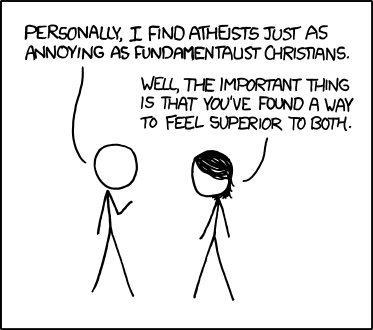
That's all for part 1. In part 2, I'll address how there is no such thing as a "radical atheist," at least not in the way often implied. Stay tuned.
1 On a very interesting note, there are some signatures in that olive branch petition you might be surprised to see. Apparently, some of those people changed their opinions in a year's span. Or maybe they signed because the Continental Congress had voted for it?
Supplimentary: Here are some blog posts that have popped up recently that have some similar ideas to mine.
1. Stephanie Zvan on radical feminism
2. Greg Laden on Occupy Wallstreet protestor who might be dismissing the groups that started the protests in the first place (esp. the left-wing nut jobs)! (Unfortunately, we can't know for sure the woman's intent based on the sign alone.)
3. More from Stephanie Zvan. This is relavent in that it discusses how movements are often ruined by those in the middle, not the extremists.
Subscribe to:
Posts (Atom)