Showing posts with label Christian Failings. Show all posts

Wednesday, April 27, 2016

Leasons Learned from the IFC: Why Christians strawman atheists

Before I go over any deeper thoughts on the "Intelligent Faith Conference," I want to go over a lesson I learned about conservative Christians and apologists that I should have realized quite some time ago. I have been bothered by the way Christian apologists will make claims about what atheists believe. It was quite common throughout the book, "I Don't Have Enough Faith To Be An Atheist," (IDHEF for short from now on) which I have blogged about. I had thought the reason was largely to make atheists seem silly in order to make their beliefs seem more reasonable in comparison. I now have slightly different thoughts.

First, let's go back to March 2010 when I attended a conference in Des Moines with my now-wife, Amy. I had attended a session with a doctor who was giving a presentation on the brain. I no longer remember the full details of the presentation (I do remember they had brought an actual brain in a vat) nor do I remember why they brought this up, but they said that everyone, including atheists, have faith. (Their example of atheists having faith, for reference, is that we have faith that our car brakes will work.) At the time, I wasn't all that familiar with Christian apologetics nor logical fallacies, so I was not able to recognize they were committing an equivocation error, but, later on, the question I had was why was it so important for them to believe that atheists have faith?

Sometime in between then and now, I would learn about cognitive dissonance theory. For the purpose of this blog post, I'll share a few paragraphs on the topic from Simply Psychology:

According to Festinger, we hold many cognitions about the world and ourselves; when they clash, a discrepancy is evoked, resulting in a state of tension known as cognitive dissonance. As the experience of dissonance is unpleasant, we are motivated to reduce or eliminate it, and achieve consonance (i.e. agreement).

Cognitive dissonance was first investigated by Leon Festinger, arising out of a participant observation study of a cult which believed that the earth was going to be destroyed by a flood, and what happened to its members — particularly the really committed ones who had given up their homes and jobs to work for the cult — when the flood did not happen.

While fringe members were more inclined to recognize that they had made fools of themselves and to "put it down to experience", committed members were more likely to re-interpret the evidence to show that they were right all along (the earth was not destroyed because of the faithfulness of the cult members).

The one big takeaway from cognitive dissonance theory is that those with strongly held beliefs have a very difficult time letting go of those beliefs when they come in conflict with observed reality and that it tends to be easier to seek out information or reasons, regardless of their truth value, to reduce dissonance. Or, as the Simply Psychology article states, "One of the points that dissonance theorists are fond of making is that people will go to all sorts of lengths to reduce dissonance."

I have also read that Festinger had observed that the cult members also began "an enthusiastic effort at proselytizing to seek social support and lessen the pain of disconfirmation." The idea here would seem to be that people feel more comfortable in their beliefs if they think others share in that belief. (This is also backed up by other psychological studies, like the Asch conformity studies.)

This brings us back to the doctor I met six years ago. I have since come to the realization that the doctor was out to convince themself that everybody believes things off of faith to gain social support for some belief that they have that they are uncomfortable with. I will also note that I recall them asking the audience if they (we) agreed. I see this as serving as further evidence that they were indeed out for social support. I have since seen claims about atheists having faith to serve essentially the same purpose.

Yeah? Well, you know, that's
just like, your OPINION, man.

Fast-forward to the present day, I was seeing my coworker make rather similar claims. When talking about the supposed resurrection of Jesus, they made some remark that everything that's written down is essentially just opinion. It was rather clear where this was going. I'll just go ahead and be blunt that there isn't any really good evidence that a resurrection happened. (As I said in my post on initial thoughts, the person, Gary Habermas, who was presented as a supposed expert on this subject, made an argument from ignorance at the end of the presentation. If they had good evidence, there should be no need for them to engage in fallacious reasoning.) My suspicion is that my coworker realizes this as well. But, as they are a believer, this would cause cognitive dissonance. So what would be a way to reduce that conflict? Proclaim that everybody believes for bad reasons, just like that doctor and others do when they proclaim that everyone believes things on faith!

It was not this interaction that led to my light-bulb moment, but this interaction did help bring to the front of my mind the thought of such experiences with believers where they try to present some sort of "everybody does this" argument to justify their behavior. It was a couple other interactions that led to my new realization.
  • On the Friday night of the event, my coworker introduced me to their friend, James, and we talked a bit about the second presentation by J. Warner Wallace, the crime-scene investigator. Their presentation roughly mirrored chapters 3 through 6 of IDHEF, so I was familiar with the arguments. I talked with James about the science behind the origins of the universe and how I find it irrational to jump to the conclusion of god because one does not find any naturalistic explanations satisfactory. Why can't one just say, "I don't know"? They did find that to be interesting, but then they went on to assist that one does need to come to a conclusion, to which I responded with a pointed "Why?!?" They seemed to think one would need to come to a conclusion in order to make decisions and, unfortunately, that is where that part of the conversation ended. (I will agree somewhat that there are indeed many moments in life where we do need to make decisions on a limited amount of information. As an engineer, I have to do so as a regular part of my job. But what decisions would I need to make based on the origins of the universe?1) James looked as if he'd never actually had this suggested before. It was a telling moment.
  • During Saturday discussions with my coworker, they made some claims along the lines that I "have a perspective" and that they "have a perspective" as well as I "have a worldview" just like everyone else does. I was also accused of borrowing from their worldview, a claim which could use further discussion in a separate post.

It was upon reflection of these events that I realized this is actually more of the "everyone does it" rationalizing, like it is with the "even atheists have faith" claims. I'm thinking that part of the reason I had missed this before is because I had not been the intended audience. It is one thing to read in a book, like IDHEF, passages that make bogus claims about what atheists believe and that we have "worldviews" just like Christians, etc. In such cases, I am not the intended audience. But in these interactions with James and my coworker, I was now the main audience. It is perhaps the reason why I remember what that doctor said those six years ago; they weren't necessarily speaking to an audience of believers. When they called out atheists, there very well could have been (and was at least one) atheists in the room with them. It is more obvious in such a context that social reinforcement is part of the goal. Another reason may be that, because the beliefs are different, I was missing the point of atheists supposedly believing things in the same way that Christians do.

One other thing my coworker said to help drive this home was that their Christian worldview comes first and foremost for them. I cannot say the same. From my personal notes on IDHEF, I have the following written down:
Another issue in this framework of presenting ideas as needing more "faith" than others is that they completely ignore conviction and importance of the belief. I’m an atheist, but I don’t have any particular attachment to the big bang theory. I largely go along with the idea of the big bang because that is what the scientific consensus is. But my world isn’t going to be shaken one bit if scientists come out tomorrow and say that this was a completely incorrect idea. [Adding: I likely wouldn't even be shaken if scientists came out and said, "Yep, there is an intelligent designer behind the universe." I'd be surprised, and a bit skeptical, but not necessarily shaken.] The theory of evolution, for example, isn’t dependent on the big bang theory (and, in fact, the theory of evolution was formed first). Nor do my views on morality depend on evolution. Can the same be said about theists who believe a god brought about the universe?

That final question was a bit rhetorical as I have already suspected the answer is often "No." But I am no longer sure those authors are actually ignoring this. Based on these interactions I had with James and my coworker, they may very well believe atheists hold the same level of conviction. I've taken issue with the way IDHEF portrays there needing to be a lot of faith to believe in, for example, the multiverse theory because I don't know any atheists who actually believe in the multiverse theory in the same way theists believe in a god that created the universe. Instead, the multiverse is little more than an interesting concept that would need more investigation, which, with current technology, is impossible and so it should remain as no more than an interesting concept until it is actually possible to investigate. Another way to phrase this is I found their comparisons of belief between atheists and Christians2 to be apples to oranges, but they were treating them as apples to apples. It now appears that they make the apples to apples comparisons out of that need to believe that "everyone does it" so that they can battle their cognitive dissonance. That is what I have learned is likely the primary purpose of straw-manning atheists. That said, the idea of trying to make atheists look silly still seems to be secondary. I saw this with J. Warner Wallace's presentation as well as in IDHEF. Part of their shtick is to proclaim that atheists have virtually no evidence for such beliefs (which is true) while they at least have some evidence.3

With that, my response to these theists and Christians could simply be, "No, I don't do what you think I do. I don't believe the way you think I believe. I don't think the way you think I think." I realize, though, it would take a lot of work to get them to accept this. Again, it appears they believe these things about atheist beliefs out of necessity for battling their own cognitive dissonance. It won't be easy for them to let go.


1 One possibility that I could see being argued is Pascal's Wager. For those unfamiliar with the wager, the gist of it is that it is supposedly better to believe in God than not because, if God exists, then you could be punished for not believing. If God doesn't exist, then it doesn't matter anyway. The problem with the wager is that it assumes that if a god exists, it will be the Christian god, which is why I capitalized the "g" earlier. The wager fails to consider the possibility of a god that might punish people for wrongly believing in the Christian god. The wager also fails to consider the possibility of a god that would punish people for believing on a wager, and so forth. In short, it is an argument that essentially assumes the conclusion, making it circular and fallacious.

2 I'm talking about only the Christians who, like my coworker, take their beliefs really seriously. There are many Christians who clearly do not take their beliefs anywhere near as seriously (and thus don't have near the cognitive dissonance to tackle).

3 On more of a side note, their so-called "evidence" tends to be little more than philosophical arguments for which they haven't or can't verify as being true. For example, "Design only comes from an intelligence." Part of the response here would be, "As far as you know," as well as "Can you prove that?" or "Where is your verification for that claim?" Likewise, it could be asked, "Where is your verification that this is actually design?" The reality is their "evidence" relies heavily on assumptions. But, here too, one can expect the theist or Christian to proclaim that atheists also have assumptions (a common one is that there is no such thing as the supernatural), so we go right back to the bogus "everyone does it" claims.

Saturday, April 9, 2016

First thoughts on the first day of the "Intelligent Faith Conference"

This weekend there is an "Intelligent Faith Conference" here in Cedar Rapids. A Christian coworker invited me to go, so I have thus far attended the Friday night session. Here, I am posting my first thoughts. I plan to go into further detail later on, which will likely involve repeating some of the thoughts here.

My first thought as far as Friday night goes is that I noticed a bit of a theme of each presentation containing some sort of "argument from ignorance." The latter two presentation really relied on the fallacious argument, while the first presentation really only implied such an argument as part of a side argument.

The argument from ignorance can be summed up as "I can't think of any other possible explanation, so this explanation I can think of must be true." This reasoning is fallacious as the truth could be with an explanation that just hasn't been thought of.

In the first presentation, the argument from ignorance appears in a story of a skeptic who refuses to watch a video of a woman being miraculously cured because the skeptic will just come up with a natural explanation. This was used as evidence that skeptics are really predisposed to not believing in god. Well, the problem here is that the skeptic doesn't even need to come up with a natural explanation. Even if the skeptic cannot come up with any explanation does not mean they have to accept the supernatural explanation. (If there is any reason to not bother watching the video, it would be because it would unlikely be any sort of "proof" for that supernatural explanation.) Yet, I got the impression from the presenter that the skeptic should accept the supernatural explanation. That would, however, be fallacious.

On that note, much of that first presentation was just a collection of stories where it was claimed that a supernatural event happened and these claims were accepted uncritically when it should be well known that humans have a tendency to exaggerate. It was not a good way to start a conference that is supposed to be about discussing why Christianity is a rational worldview.

The second presentation was essentially centered around the argument from ignorance. That presenter was offering a process-of-elimination approach to concluding that there is a god, using the fact that such an approach is useful in his line of work as a cold-case detective. The problem here is that such an approach works when the list of possibilities is contained, as it seems to be with detective work, but not so well when that list is not. By a contained list, I mean that we know, or can be reasonably sure we know, that we have the full list of possibilities. In such a case, if all but one possibility have been eliminated, we can be reasonably sure the remaining possibility is correct. When we don't have a contained list and don't know all the possibilities, then using such reasoning becomes the fallacious argument from ignorance. The presenter tries to make his position seem reasonable by making a point that he's using the same skill set with his religious beliefs as he does with his job. The failure here is in failing to ask the question as to whether or not it is reasonable to actually do this and I would say the answer to that question is "No, it is not reasonable."

The third presentation didn't really hit the argument from ignorance until we got near the end. This presentation was about the resurrection and it was largely about how scholars largely agree to a set of 12 facts. I'll have to go over the facts later (I only captured 8 of them at the event, but I suspect I can find the other 4 on the presenter's website), but it ended up boiling down to a "I'm going to believe that there was a resurrection until someone can present me with a reasonable alternate explanation." Skimming over the 8 facts that I had captured, none of them come close to conclusively demonstrating a resurrection happened. What had started out as a somewhat interesting presentation came crashing down at the end with rather obvious (well, at least to me) fallacious reasoning.

In summary, if these are their best examples of "intelligent faith," it's going to be the poor reasoning skills of humans that keeps Christianity alive.

Monday, June 29, 2015

Arrogance called out in SCOTUS dissents vs. Christians

Something occurred to me regarding my last post: Some of the Supreme Court justices on the losing side of gay marriage accused their fellow justices of arrogance much like I did with liberal Christians. They accused them of having special insight that no one had had for thousands of years prior, much the same as I did with liberal Christians. I disagreed with those in the dissent for committing an argument from tradition. Yet, I still think I'm correct in calling out Christian arrogance. Here's the difference: With Christians, they are claiming that wisdom was bestowed upon some humans by Jesus nearly 2000 years ago, but it is only just now that humans are figuring out that wisdom. In the other case, there is no such claim; it is a case of humans figuring out their own wisdom, which is a process that takes time. Plus, we can see the gains in wisdom over the course of time, whether it be creating a democracy in an age dominated by monarchies, ending slavery, allowing non-landowners and eventually women to vote, etc. There's no special insight here. It is, as Martin Luther King, Jr. described it, the long moral arc of the universe bending toward justice.

Saturday, June 27, 2015

Arrogant pro-LGBT Christians

These may be some of the most obnoxious Christians one can encounter. They actually hold OK views in regards to humanity, but it seems like they want to credit Christianity for it. They'll go about calling themselves "true Christians." It is so terribly arrogant. Just think about some of the implications:
  • Most Christians throughout history have not been "true Christians." And it is in only recent history -- we're talking only 20 years here -- that the percentage of "true Christians" has risen, and risen quickly.
  • No Pope has ever been a "true Christian." Not even the current one that people like to believe is progressive.
Sorry, but I find it really hard to believe that after nearly 2000 years Christians would only just now be reaching a tipping point of the majority discovering the "true" message of Jesus. Not buying it. As far as I can tell, the change in attitude is all thanks to the LGBT community refusing to put up with discrimination. Christianity played no part in this. Yet, these Christians act like it somehow did. It's frustrating because it's been Christianity that has provided the most resistance to change and it will likely be Christianity (and other religions) that provide the most resistance to changing future injustices. These liberal Christians are doing the world no favors by trying to keep their mythology alive.

Thursday, June 11, 2015

Buying the Morality Pitch - The Failure of the Religiously Indoctrinated to Think Through Morality

I saw an article about Jason Lisle, a doctor of some sorts, speaking with Ben Seewald (husband of Jessa Duggar) claiming atheists really don't exist because, essentially, some book says there is sufficient evidence for the existence of god. Yeah, the book was, of course, the Bible. If the circular reasoning wasn't bad enough, they continued to provide a cliche morality argument as a reason atheists don't exist. The argument is rather simplistic and goes something like the following: "God is necessary for there to be a difference between right and wrong. Atheists believe there is a right and wrong. Therefore, atheists really believe god exists." They do have arguments for why they think a god in necessary, but they're not all that great of arguments.

This all just got me to thinking how often I hear morality used as an assertion for the existence of god...people flat out saying that I'm wrong because of this. (Or people saying that religion is required for morality.) But, really, morality, at a basic level, is actually quite simple...if one would bother to put thought into it. So whenever I hear some Christian bring up morality and making claims such as this, I'm often at a loss for what to say because they essentially lead me to suspect that they've just gobbled up what their pastor has told them at church without giving it a second thought. Is it really worth my time to engage? Because their minds seem rather closed off to the topic.

Also, they seem to be really selective in their examples. By which I mean they select examples that would seem to prove their point while avoiding often numerous examples that don't. Jason Lisle uses an example of baking powder, saying, "What one chemical accident does to another is morally irrelevant. I mean when baking soda and vinegar react and they fizz up...that's just what they do. You don' get mad at the baking soda." The idea here being that without a god and us just being a chemical "accident,"* it doesn't make sense to get mad at an accident.

Except we do. I can quickly think of numerous counter examples: People getting upset at a tornado ripping up their town. People getting upset at a rain storm(s) for causing flooding. People getting upset with tectonic plates for causing earthquakes. Etc, etc, etc. Sure, they're not upset with those things in the same way they'd be upset with people, but that has to do more with the difference in the sentience of the thing they are mad at. The point here is that people do get upset over chemical accidents. (It is also worth pointing out that people speak of "Mother Nature" as though nature were sentient.)

I find it rather obvious why Lisle does not use those examples. He's saying since getting mad at chemical reactions is not rational that a god is necessary to create a moral standard in order for us to be mad at other human beings. Now, here's the question he doesn't want you to ask: "Why would god set up a moral standard in such a way that we'd get mad at inanimate objects?"

Any answer I can think of is not satisfactory. They can't say that this is not part of the moral standard created by their god and is just something that humans do because that would shoot down that premise that it is impossible without the involvement of a god to get mad at a chemical reaction. Another option I could see is to say that this god's moral standard is not perfect. I shouldn't need to state why that answer is problematic.


What I really want to talk about, though (which was only given a very brief mention in the linked video), is how they tend to bring up murder as their key example. The idea seems to be that since virtually every culture has prohibitions against murder that there must be a universal standard.

It always seems a bit silly to me because it should be blatantly obvious that there are numerous issues in which humans do not agree. A few excuses are made for this. For some, they try to claim that there only appears to be a difference, but if you take a closer look, there is no difference at all. One example of this I found in the book I Don't Have Enough Faith to Be an Atheist was about Hindus not killing cows. It isn't that Hindus have a different morality, see! It's because Hindus believe their grandmothers get reincarnated as cows and they don't believe in killing their grandmothers, just like you and me! I just find that jaw-droppingly stupid. (For one, while I'm not an expert on Hindu religion, I don't believe that's quite how it works. I had always thought the belief in reincarnation also included what they considered "lesser" animals that they have no problem killing.) A second example, also from that book, used the killing of so-called "witches." They excused that claiming that people thought these "witches" had killed people. That would imply they think capital punishment is acceptable. That, then, is problematic because they then need to explain why people disagree on capital punishment.

Getting back to murder, it's just not true that this is universal in quite the way that they claim. Most cultures are absolutely fine with murdering people they deem to be enemies. Oh, but I suppose that goes back to the idea of capital punishment. I'm going to suspect that they don't call that "murder;" that's just "killing." "Murder," you see, is an unjustified killing, but all these other forms are totally justified. Or so they would claim. I'm darn near rolling my eyes just writing this over how weaselly Christians can be about their claims. It's not only that their claims are silly, but they are a bit frightening as well when I think at how easily they can find justifications for killing people...and then turn around making these claims that one needs religion to be moral.

Yet, as I have suggested, figuring out murder isn't all that hard. We can work it out with only just a few premises:
1. I don't have a desire to die anytime soon.
2. The family members of a person who is murdered often wish to seek revenge, often in a form of "an eye for an eye" type of revenge.
From here, we can then figure out that if I were to kill someone, then others would want to kill me. I don't want that happening because I don't want to die anytime soon. So, if I don't want that to happen, what should I not do? Right! I shouldn't murder!!! Pretty frickin simple.

What would probably happen now is the Christian will engage in a tactic called "shifting the goal posts." They'll likely now assert that it is because of their god that I have that desire not to die and/or it is because of their god that people seek revenge. At such a point, I'm most certainly done engaging. If a person comes to me with a claim and I show their claim to be bogus, they don't get to readjust their claim. If that was really their argument, they should have started there in the first place. That they didn't says to me that they are just trying to fit their god into the equation anyway that they can. Much like I said near the beginning of this post, it shows that they are beholden to the idea of a god and are not actually open minded. I'm not interested in carrying on such dishonest discussion.

* I also love how they use loaded terminology to make their points. Go ahead and look up "accident" in a dictionary. While you can probably find some definitions that fit what he's trying to describe, the more common definitions of "accident" refer to an event being unfortunate. That, though, seems to be the point of using such language...get your audience to react with a "I'm not an accident!!!" emotional response as opposed to a rational response.


I also want to bring up another odd argument Christians will sometimes use, which is to compare morality to math. I suppose the idea here is that they would think most people would agree that math is universal. Therefore, if they can make morality seem much like math, then one would have to agree that morality is universal, too. This comes from C. S. Lewis's Mere Christianity where he is quoted as follows: "Think of a country where people were admired for running away in battle, or where a man felt proud of double-crossing all the people who had been kindest to him. You might just as well try to imagine a country where two and two made five."

In order to be making such a comparison, though, he would need to think that a god is necessary for two plus two to equal four. Seriously? He thought it takes a god for two sets of two objects to produce four objects? That's just mind boggling. What that says to me is that this person is so predisposed to the existence of god that they may be beyond the capability to be reasoned out of that belief. (It also suggests that they think that anything universal must come from a god. Yet, they don't really bother proving that premise, which is largely why such arguments don't phase me. In order to be comparing morality to math to show that morality comes from a god, they also need to demonstrate that math comes from a god.)

On a side note, C. S. Lewis is said to have been an atheist at some point of his life, so one might argue that he wasn't predisposed to the existence of god. I disagree. While I'll accept this claim that he was an atheist, he has also been said to have been "mad at God for not existing." It would seem to me that he was an atheist predisposed to believing in a god, even if he couldn't actually convince himself at the time. In short, one need not actually believe in the thing they are predisposed to believing.

Wednesday, April 2, 2014

Not sure what Bible this Catholic priest reads...

Short post today. Regular FOX News contributer Father Johnathan Morris was on that station recently to talk about the new movie, Noah. I just want to cover the bits that caught my attention. First, the video, via the RawStory:


“It’s a classic case of the book is much better than the movie.”

Oh, man! The book sucks. So...the movie must be horrible!

It’s also escapism from the true story, from what’s in the Bible.”

Ha! If you call a "tail" a "leg," then does a dog have five legs?

“God comes across as this enigmatic, impersonal force that tells you to do crazy things.”

Well, I'll admit that Yahweh does appear to be a bit more personal in the book. But the "tells you to do crazy things" is totally on character.

“[In the movie, Noah] is borderline schizophrenic...The real story is unbelievably inspiring. [Noah] was a great father...”

Well, it's nearly unbelievable how people find that story to be inspiring. Inspiring how? That's a question I'd like to ask as I have doubts I'd get a clear answer. As for Noah being a great father, I wonder what Morrison basis this on. The Bible says pretty much jack about Noah's fathering abilities. There are at best two places. Genesis 6:9 includes a part that says, "Noah was a righteous man, blameless among the people of his time." Does that mean he was a good father? Maybe. But Genesis 9 contains a part where Noah condemns his son, Ham, into slavery for essentially getting a laugh at finding Noah passed out drunk and naked. That's what a "good father" does? Please!

“Just wrong starting point. Didn't start from the point of view of faith.”

This, I think, is where Morrison gets the crazy ideas that Noah was a good father and that the story is inspiring. What Morrison is really saying here, then, is that the movie needed to start from the point of view that the story is actually a good story as opposed to what the story actually says. In other words, the movie needed to start from what Christians imagine the story to be.


Otherwise, I have not seen the movie yet. Not sure if I'm going to anytime soon or not.

Thursday, January 31, 2013

The two types of "questioning"

   In the few years I have been paying attention to religion, I have noticed the occasional Christian act like they have seriously questioned their religion. If that were true, they would no longer be Christian. I have also, as I have noted in another post, heard Christians use arguments that are seriously flawed. As I said in the one post that I have thus far written on that topic, "the goal is to find an argument that successfully defends the faith, not one that is logically sound." I do believe that these people who say they questioned their religion really did so, but my suspicion is that they were not out in search of the truth; they were out to resolve contradictions they had with their religion. (In a recent case, for example, I suspect the conflict was between how the Bible says homosexuals should be treated versus how this person personally thinks homosexuals should be treated.) The question(s), then, would deal with how they can resolve this conflict(s). (For the example I provided, the "answer" may very well be what I said in that other post was a dumb argument — that the "law no longer applies.") The first type of questioning, then, is a type of questioning that is in search of answers that appeal to the questioner's emotions...answers that, on the surface, make "sense." (As another example, if one were to question how they can be Christian when it is just another rel

   The second type of questioning is a robust form of questioning in which the questioner searches for the answer that is most likely to be true. This type of questioning should use methodological skepticism to evaluate answers.

   Allow me to provide a brief example of how these different types of questioning could play out in real life. It would seem that there are Christians out there who struggle with Christianity being a religion. My hunch is that they see a bunch of other religions out there that they reject as false and perhaps they realize that there really isn't a good reason for them to not reject Christianity as well. The solution? Christianity is not a religion! It's a personal relationship with Jesus!* If you engage in the first type of questioning, you will likely accept this as an answer. If you engage in the second type of questioning, however, you will come to the conclusion that there is no such thing as a personal relationship with Jesus. Even if you did not go so far as to come to the conclusion that Jesus, if there even was such a person, is long dead and gone, you should at least be able to recognize that there are lots of people who make such a claim, yet many (strangely enough!) of them cannot agree on the character of Jesus. You should realize that questions like, "What would Jesus do?" make little sense in the way we frame such a question. It's asked in a way as though we can't just go ask Jesus himself. Well, if there are these millions of people who have a "personal relationship" with Jesus, why can't we? I wonder what type of answer the first type of questioner would except...

* Alternatively, I have seen a similar idea that one is not a Christian, but is rather a follower of Christ. If you use the first type of questioning, such a suggestion would likely be embraced. If you use the second type of questioning, you will come to the conclusion that there isn't an actual difference between the two — it is just a crafty way to reframe one's religious beliefs without actually changing the beliefs themselves.

Wednesday, May 23, 2012

They never see the irony

   So there was a state representative from Mississippi calling for the killing of gay people in the news just the other day...but that's not what I'm really here to talk about. What he said included, "The only opinion that counts is God’s: see Romans 1:26-28 and Leviticus 20:13." Leviticus is the verse that calls for the killing of gay people, which I already knew. I was curious about the Romans verse. It states the following:
26 Because of this, God gave them over to shameful lusts. Even their women exchanged natural sexual relations for unnatural ones. 27 In the same way the men also abandoned natural relations with women and were inflamed with lust for one another. Men committed shameful acts with other men, and received in themselves the due penalty for their error.

28 Furthermore, just as they did not think it worthwhile to retain the knowledge of God, so God gave them over to a depraved mind, so that they do what ought not to be done.
   So I became curious as to the context. Apparently, Paul is telling the Romans how the Big G is taking out his wrath on the nonbelievers...nonbelievers who are supposed to be able to see invisible evidence.
20 For since the creation of the world God’s invisible qualities—his eternal power and divine nature—have been clearly seen, being understood from what has been made, so that people are without excuse.
   This is essentially the argument from ignorance. (You can't explain the tides; therefore, God.) Yet, this is still not what I am here to discuss. It is rather the next three verses that I find interesting. (Emphasis mine.)
21 For although they knew God, they neither glorified him as God nor gave thanks to him, but their thinking became futile and their foolish hearts were darkened. 22 Although they claimed to be wise, they became fools 23 and exchanged the glory of the immortal God for images made to look like a mortal human being and birds and animals and reptiles.
   That sort of sounds familiar...


   Of course, there are a few differences: (1) Christians didn't "exchange the glory of the immortal God" for this image. Instead, they strangely conflate the two. They treat Jesus as both god and mortal human. On the one hand, they try to claim that Jesus "died" for our sins, but then on the other hand they try to claim that Jesus is part of that "immortal God." I'm sorry, but something that is immortal, by definition, cannot die. So either Jesus is (was) mortal and could have died on that cross and then not be part of that "immortal God" or he is immortal and therefore could be part of that "immortal God" but could not die on a cross. It can't be both; that would be a violation of the law of excluded middle. And, finally, (2) there are no "birds and animals and reptiles" in the image. The big irony, still, is that the main Christian image is "made to look like a mortal human being."

   Then again, I already knew Christians are pretty oblivious to irony. They are, after all, very good (or bad, depending on perspective) about ignoring Matthew 6:5-8
5 “And when you pray, do not be like the hypocrites, for they love to pray standing in the synagogues and on the street corners to be seen by others. Truly I tell you, they have received their reward in full. 6 But when you pray, go into your room, close the door and pray to your Father, who is unseen. Then your Father, who sees what is done in secret, will reward you. 7 And when you pray, do not keep on babbling like pagans, for they think they will be heard because of their many words. 8 Do not be like them, for your Father knows what you need before you ask him.

Monday, May 21, 2012

"Organized" religion isn't the problem!

...Well, it isn't, but not the way some Christians suggest.

   It pleases me — PLEASES, I SAY! — when Christians (typically of the more liberal variety) attempt to claim that religion isn't a problem, it's just that damn organized religion that's problematic! To which I say, "Bollocks!"

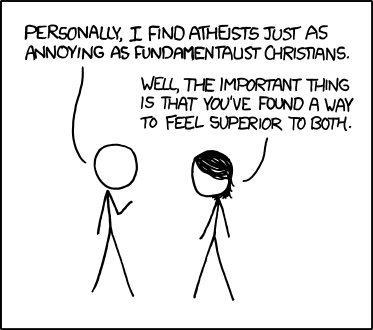
   What can I say? There was a vote on a ban of gay marriage in North Carolina recently and I found an article about it and in that comment section (it was on MSNBC, but I'm not sure which article or where to find the exact comment now) some Christian was going off about how Christians can't take the moral high-ground because of prior moral failings (agreed), but then seemed to blame this on "organized religion" and had to make it clear he was not an "Atheist" (with a capital "A" because, I suppose, he thinks atheism is a religion). This really causes me to facepalm when I see that there is one survey (how well this was conducted, I do not know) that found about 97% of atheists/humanists support legal gay marriage. (Also, Gallup finds that 89% of non-Christians support gay marriage.) And this guy seemingly wants to distance himself from such a group to make it clear he belongs to the Christian club, or at least a religion. Or maybe he thinks atheists eat babies or are communists who worship government? Most of all, I suspect he's trying to make himself feel superior. It reminds me of the xkcd comic.

   Which brings me right to my biggest point on this issue: there is really no such thing as religion without organization. This commenter goes out of his way to point out he's not an atheist. Why? Seriously, why? As I already suggested, I suspect he's trying to make it clear that he is himself a Christian (without having directly said so). But why is that important? If you think organized religion is so horrible, why imply that you are a member of the group? Perhaps he's afraid of social consequences for denouncing religion. Which brings me to the reality that religion needs organization to survive. I credit the fact that I am an atheist much to not having a religious upbringing. I didn't have to fight off years of people telling me that a god is real. Granted, my parents could have brought up religion in the home more often than they did (which was virtually never), and if they had, I might not be an atheist.

   But what about my children (when Amy and I get around to adopting)? I'm not going to be teaching them religion as literal truth. I doubt Amy would, either. So where could they possibly pick up religion? I mean, without organized religion? Could some friends teach them about religion? Maybe, but those friends might also believe Spiderman is real, too. So when Spiderman becomes fake, so does religion. At best, I would say, they might come up with something of their own, but would they get into anything like Christianity? Probably not.

   I raise this because there have been cases of the children of atheists becoming religion. Some, even pastors (i.e, William Murray and Stephen Kagin). But would this have happened without organized religion? So often I hear stories from atheists who began life as non-religious or not devoutly religious and then got pulled into church or a college prayer group through friends. That's organized religion, even if the organization may be relatively small in comparison to, say, a juggernaut like the Catholic Church. Never have I heard anyone claim that they became religious from a friend merely telling them about Jesus. No, it seems to take some sort of church experience to convert.

   Think about that. If parenting were the primary way to pass on a religious belief and there were no effective conversion methods, specific religions would gradually fade away as parents, such as mine, fail to pass on their beliefs. Now, new religions may — and probably would — spring up from people creating new religions, but even those wouldn't last. About all that might last are the simplest of beliefs. People still believe in astrology, for example, but it is relatively simple. At least it seems to be that way anymore. At one time, I think it used to be quite more complex, by which I mean people spent much more time actually looking at the alignment of the stars and planets because they actually thought that mattered. Today? It wouldn't surprise me if many astrologers know the position of planets, but recognize that all they really do is make up stuff in horoscopes. More importantly, though, there are no scriptures or really any dogma that is tied to such a belief. Just think about that for one, brief minute. What is the Bible, after all? It is an organized collection of stories, poetry, and letters.

   Yet, I can imagine there would be some objections about how that is not what they mean by "organized." Then what do they mean? Why do I get the feeling that their particular brand of Christianity is not organized but everyone else's is???

Friday, April 27, 2012

This doesn't fix the problem.

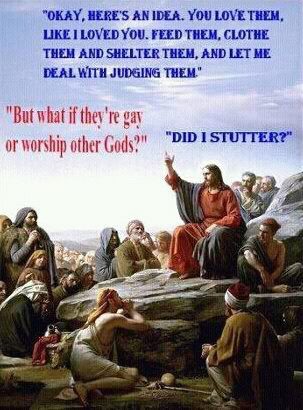
   Silly liberal(?) Christians! I was browsing the timeline of a Facebook friend and found this ridiculous image. In searching for the image, I found a webpage with a likewise silly comment:
YES, THANK YOU! It’s so hard sometimes to tell non-Christians that you’re Christian when you live in a world where “Christian” means Gay-basher and determiner of law.

My type of Christianity is the kind that LOVES and DOESN’T judge. So two men dig each other. Get over it. So the laws of Christianity don’t govern the whole country. Get over it and read the constitution.

Jesus was a rad dude, you guys.
   Ohhhhhhkay. But this doesn't fix the problem. First, note that this poster seems to admit that the laws of Christianity could allow discrimination of gays, but that Christians can't do that here in the USA because we have a First Amendment that prohibits religious laws. What if this poster did not live in such a country? What if they lived in Uganda, where there has been a struggle over a "kill the gays" bill? Might that be compatible with "the laws of Christianity"? Let me put it this way: If one of your defenses of Christianity involves pointing out that Christians can't have their way because we live in a secular country, that's not an argument in favor of Christianity. That's an argument for secularism. Not only that, it's an admittance that secularism is better than Christianity. Sadly, this Christian likely does not recognize the implication of hir statement.

   Moreover, the conservative Christian has arguments at their disposal that are good counters to this liberal Christian's argument about laws. Their argument could be that God's law is higher than, and therefore trumps, human's law. "So what if the USA has a constitution? God's law is higher. Is the liberal Christian really trying to place man above God?!? That's what those damn atheists do!"

   As for the problem with the image itself, the more liberal Christians can't actually say that there is nothing wrong with being gay or believing in other gods...at least not without abandoning some of the core doctrines of Christianity1. (At which point, why would you call yourself something you're not?2) The poster I quoted says "Get over it," but could they actually say, "There's nothing wrong with that"? Liberal Christians, at best, can speak about love or not judging, as this poster did. They'll say things like how Christianity teaches to love your neighbor. And from such ideas they derive catchy little phrases like, "Love the sinner; hate the sin." But they can't actually say that homosexual behavior is not a sin. Where would such a notion be supported in the Bible?

   Ideas of not judging might work to counter bullying, but what about reparative therapy?3 That's the "therapy" that tries to "cure the gay." Can liberal Christians really object to such a thing? Well, they can object, but what's their argument against it? They can't really argue that it's being judgmental. I would argue that such therapy is simply trying to help people free themselves from sin. Such therapy is out of love! If the liberal Christian then tries to argue that you should just allow people to sin, then they open up the floodgates. Do we then try to help alcoholics or other drug addicts? Just let them sin! Men who beat their wives? Let them sin!

UPDATE: I want to add that I have heard arguments from some pastors that helping homosexuals is like helping an alcoholic. Additionally, I do find these to be good arguments...at least if you agree to the premises that both homosexual behavior and drinking are problematic. I don't agree, which is why I ultimately don't find the argument convincing, but what about the liberal Christians? Do they also not agree? /UPDATE

   Can the liberal Christian really say that? Take another look at the image. This is encouraging Christians not to judge, but there is still someone who does get to judge—Jesus himself! And what is Jesus going to do with the gays and those who worship other gods? Is Jesus going to send them to hell? If so, how can the liberal Christian just sit by and do nothing while the homosexual dooms themselves to eternal damnation? Think about it—if you saw a deaf person walking along train tracks and a train was approaching from behind, could you just stand and watch the deaf person meet their death? Wouldn't the loving thing be to save them? It would seem, then, that the Christians that are the truly loving Christians are those who want to help gay people with their sin4 or those who aggressively proselytize to those who believe in other gods. It is the liberal Christians who say "Get over it" that are truly the heartless ones, despite what they claim.

   To be fair to the liberal Christians, they may not believe in a hell that involves eternal torture. They may believe hell is just separation from god or annihilation. Still, if they believe heaven is a better alternative, don't they, out of love, have to help those who might not be going to heaven? Especially those who believe in the wrong god, and maybe even the nonbelievers! (Some Christians believe that all you have to do is believe in Jesus and you'll be saved regardless of your sin. Thus, the gays are safe as long as they are Christians. The non-Christians, however, are still doomed. I know of few Christian denominations, Rob Bell's being one of them, that promote an idea of universal reconciliation. But I would expect many of these Christians to reject the notion of judgement, so this image doesn't apply to them anyway.) On top of that, it is not even the beliefs on hell of the liberal Christians that matter. It is the views of the conservative Christians (or those who believe in a torturous hell) that do. Before liberal Christians can even suggest that gays or non-Christians be allowed to live as they please, the liberal Christian must first demonstrate that those people aren't going to receive ill-treatment in the afterlife. (Which they can't, because there is no good evidence that such a place exists, let alone the god they believe in.) If you look at that which Rob Bell speaks, he speaks about "Jesus' message of love, peace, forgiveness and joy." However, the believer in hell can point to the many verses that speak of "weeping and gnashing of teeth. And then the liberals will argue that doesn't mean what it appears to mean, etc...because that's such a winning argument...or not. (Why couldn't a supposedly all-powerful god deliver a message that wouldn't be up to interpretation? Jesus could just as well have stuttered! Assuming he even existed and said anything at all.)

   Otherwise, what argument does the liberal Christian have against reparative therapy? Homosexuals were born that way?5 First, that's a secular argument. Show me where the Bible says that! Second, as per the judgement problem, even if gays are born that way, wouldn't it be the duty of Christians to help gays not give in to their natural behavior? Sure, you might not be able to get them to live as though they were heterosexuals, but wouldn't helping them abstain from homosexual behavior be a noble deed?

   As for the topic of worshiping other gods, what liberal Christian (again, except for those that subscribe to universal reconciliation) can object to proselytizing? Proselytizing has to be considered a loving activity if it will help get people in Jesus' good graces.

   In summary, liberal Christians, if they try to make arguments from Christianity against gay-bashing or other discrimination, appear to have little choice but to paint themselves into a corner. Sure, it's not the most visible corner, but a corner nonetheless. The best arguments that they have at their disposal are actually secular arguments, which says more about the superiority of secular morality than it does about Christianity.

1. Claiming there is nothing wrong with worshiping other gods would be in clear contradiction to the First Commandment.

2. This reminds me of some comment I once saw posted on a YouTube video. The comment had something like, "I disagree with most of what the [Catholic] church says, but I'm still a Catholic." Imagine if someone said they disagreed with most of the Democrats' party platform, but said they were still a Democrat. Would that make sense? Yet, the tribal nature of religion is so strong that people can say such things with a straight face.

3. And if you're a liberal Christian that sees nothing wrong with reparative therapy, don't be surprised when non-Christians treat you like a bigoted conservative Christian.

4. It is of my opinion that a lot of conservative Christians are bigots, plain and simple. (Especially those that demand gays be put to death.) However, there very well could be a number who are indeed genuinely concerned about gays going to hell. Or maybe they're even worried about what judgements Jesus may have in store for them if they stand idly by. Take Kirk Cameron, for example. Is he a bigot? I don't think so. I don't think he's very intelligent, but not a bigot.

5. The "born that way" argument also has some theological problems from the Christian standpoint. If their god created humans, then it created them to be gay. And then it condemned gays for being the way it created them to be. This is not the depiction of a loving god. Though, I know...I know...many Christians will blame "original sin" rather than their god.


UPDATE: One thing I forgot to say when I initially posted this is that I find it wrong (not like a criminal offense type of wrong...more like a "bad idea" type of wrong) to believe in gods without evidence. On that, there is no more good evidence for Jesus than any other supernatural god claim. (Perhaps there is more "evidence" but it is of the very shitty variety where it doesn't matter how high you stack it.) Believing in Allah or Baal or Zeus is no more wrong than believing in Jesus.

Monday, January 2, 2012

Sacrifice? What Sacrifice?

   I am working on the concept for a post involving how Christianity is supposedly about love. I have realized that I will have to talk about the supposed "sacrifice" of Jesus because, as I understand it, many Christians consider that to be some great act of love. I have also realized that such a discussion is probably worth a post of its own, so...here it is!

   First, a disclaimer: For the sake of argument, I will be assuming that Christianity is basically true—there is a God, and Jesus actually existed on earth, and the Bible accurately quotes Jesus, etc, etc. And I will use language as such, but my personal views are, of course, that it Christianity is mostly made up stories, just like any other religion.

Saturday, November 26, 2011

Quiz Time!!! - Answers and how I did

The following post contains answers to the Christmas Quiz posted earlier. If you'd like to take the quiz first, click here. Otherwise, answers are below the fold.

Here are the answers:

1. What year was Jesus born?

a. We don’t know for sure, since the gospels disagree irreconcilably.
b. We don’t know for sure, but the gospels agree it was during the reign of Herod the Great (died around 4 B.C.).
c. We don’t know for sure, but the gospels agree it was when Quirinius was governor of Syria (6 A.D.).
d. We don’t know for sure, but the gospels agree it was the year the moon was in the seventh house and Jupiter aligned with Mars.
e. D’uh! The year zero, of course.

Note: Only two of the gospels even mention Jesus’ birth. Matthew tells us it happened during the reign of Herod the Great. Luke tells us it was when Quirinius was governor of Syria. Which is a problem, since Herod died c. 4 B.C., and Quirinius wasn’t governor until 6 A.D., so one (or both!) of them can’t be right…


2. According to the Gospels, what day was Jesus born?

a. Dec 25th.
b. Dec 24th.
c. No date is given in any gospel.
d. The day of the Winter Solstice.
e. The third night of Hanukkah.

Note: Originally Christians didn’t celebrate birthdays at all; that was what heathens did. Being born into this sinful world was nothing to celebrate; what mattered was leaving it! So they celebrated feast days of saints on the date of their glorious deaths. It wasn’t until the fourth century that Christians began wanting a birthday for their god, too. So they stole the date from…


3. What pagan holiday did later Christians “borrow” to celebrate Jesus’ birthday?

a. The Greek Brumalia festival of Dionysus
b. The Roman feast of Saturnalia
c. Dies Natalis Solis Invicti (“the Birthday of the Unconquered Sun”)
d. All of the above
e. None of the above

Note: All of the above and then some! Throughout the ancient pre-Christian world pagan gods like Mithra, Sol, Elah-Gabal, Frey, Dionysus, Adonis, Horus and many, many, more all had their rebirth on the shortest day of the year, the winter solstice, and their worshippers rejoiced at the Sun’s “rebirth.”

Likewise, there were plenty of pagan demi-gods who were sired by a god and born of a mortal woman. Funny, but Matthew and Luke are the only gospel writers who think that Jesus was born of a virgin. Mark’s Jesus appears to be a completely human being who becomes chosen by god to become savior, and then immediately gets sent to be tested in the wilderness by Satan (that was helpful of him) for 40 days to see if he’s up for the job, and John plainly states that Joseph – not God – was Jesus’ father (1:45) without making any fuss about it.


4. So what day was Jesus really born?

a. Jan 6
b. Feb 2 (Groundhog Day)
c. March 25
d. We can’t be certain.
e. During Sukkoth, the Jewish Feast of Tabernacles

Note: Actually, different Christians have argued for all of these dates and still more. January 6th became the traditional date of Jesus’ baptism and Epiphany (the twelfth day of Christmas and the traditional day the Wise Men visited the baby Jesus). Interestingly enough, it was also the date of the solstice on the older Zoroastrian calendar. This Dec. 25 vs. Jan. 6 dispute was a real contention among believers; the Syrians and Armenians refused to accept December 25, accusing the Romans of sun worship and idolatry. In Eastern Orthodox tradition, January 6 is still the most important day of the Christmas season and Armenians consider it Jesus’ real birthday even today.

And there were plenty of other guesses about Jesus’ birthday. Clement of Alexandria reported that some used the Egyptian calendar, placing it on 25 Pachon (May 20), others on the 24th or 25th of Pharmuthi (19th or 20 April). Other traditions used the Jewish calendar and had Jesus born during Hanukkah (which falls anywhere between late November and late December) or during Sukkoth, the Feast of Tabernacles (which comes anywhere from late September to late October). Clement dismissed them all as superstitions – and maintained Jesus’ real birthday was November 17, 3 BCE.

Today Bible scholars are in no better shape and can only point to the clue that the shepherds were in their fields, concluding it must have been sometime in the fall – or maybe the spring… Still other birthdates for Jesus celebrated by Christian sects have included February 2 (Yes, Groundhog Day!) and March 25, (which is also the Spring Equinox) now celebrated as the Annunciation and considered the date of Jesus’ conception; Needless to say, even though December 25th finally won out over January 6th and the rest of the competition (in the West, anyway), no one had any idea what day Jesus was really supposed to have been born – if he was ever a real person at all in the first place… (see my book Nailed for more details on that…)


5. According to Mark (the oldest gospel) where was Jesus born?

a. He doesn’t say.
b. By the chimney, with care.
c. In his parent’s house in Nazareth.
d. A manger in Bethlehem.
e. A cave in Bethlehem.

Note: Biblical scholars overwhelmingly agree that Mark is the original text that Matthew and Luke borrowed from to create their own gospels (Luke contains 50% of Mark, and Matthew a whopping 90%). But in Mark, nothing is said about Jesus’ birth at all. He arrives on the scene as an adult, at his baptism. It’s only Luke who has Jesus born in a manger in Bethlehem. Christian tradition says the manger was actually in a cave – today the Church of the Nativity is built over it. Interestingly, in pagan mythology (not to be confused with Christianity), many other sun gods were born in a cave, and in fact, the Church Father Jerome noted that the cave of Jesus’ birth had also been a sacred shrine to the pagan god Adonis…


6. According to Luke, who were the Wise Men?

a. The Magi, a group of 2 – 12 Zoroastrian astrologers from Persia.
b. Three kings of orient bearing gifts of gold, frankincense and myrrh from afar.
c. There were no Wise Men.
d. Cupid, Donder and Blitzen.
e. Melchior of Persia, Caspar (or Gaspar) of India, and Balthazar of Arabia.

Note: There are no wise men in Luke’s story – they only appear in Matthew’s story. He has the unnamed, unnumbered group of “wise men from the east” follow the miraculous star of Bethlehem to Jerusalem and panic wicked King Herod with their news that a new King of the Jews has been born in Bethlehem. This incites Herod to kill all the baby boys in that region, and causes Joseph and Mary to flee to Egypt with baby Jesus. When an angel later gives them the all clear, they return, not to their home in Bethlehem, but to a new home in Nazareth. (Incidentally, you would think Zoroastrian astrologers from Persia were all three bad things by Christian standards, wouldn’t you?)


7. According to Matthew, who showed up on the night of Jesus’ birth?

a. Shepherds keeping watch over their flocks by night
b. An angel and a multitude of the heavenly host
c. The prophet Simeon and the prophetess Anna
d. Ten lords a-leaping
e. No one.

Note: another trick question – in Matthew’s story, no one witnesses Jesus’ birth at all; he simply says Jesus was born in Bethlehem of Judaea in the days of Herod the king (2:1) with no details. It’s only Luke who tells the story of Mary and Joseph coming to Bethlehem from Nazareth for a Roman census, finding no room at the inn and being forced to give birth in a stable, attended by humble shepherds and a host of angels.


8. What happened after Jesus’ birth?

a. Impossible to say for sure – two of the gospels tell completely contradictory stories, and the other two say nothing.
b. Good tidings were brought for him and his kin; and then figgy pudding, for they would not go until they get some.
c. Scary stuff: An angel warns Joseph to flee their home in Bethlehem for Egypt. Herod kills all the baby boys in the region. After Herod’s death, they return to Judea but are afraid of Herod’s son, so they move to Nazareth in Galilee instead (evidently Matthew forgot that Galilee was ruled by Herod’s other son…).
d. Happy stuff: The shepherds spread the good news to all, baby Jesus is circumcised, and after the obligatory 40 days for ritual purity, brought to the temple in Jerusalem where prophets hail him as the Christ. They return home to Nazareth and go back to Jerusalem every year for Passover until Jesus is twelve.
e. We aren’t told, the gospels immediately cut to his adulthood.

Note: Mark and John’s gospels ignore Jesus’ childhood years. Mathew and Luke’s do tell of his birth – but they tell two completely different stories. The two nativity tales contradict each other at every point. For just one example, Matthew has Joseph finally arrive in Nazareth for the first time only at the very end of the story; while in Luke Mary and Joseph not only both start out in Nazareth, but they go back and forth from Nazareth to Jerusalem for Passover every year during the time when Matthew has them hiding out in Egypt! Remember too that Matthew’s takes place sometime before 4 B.C. and Luke’s takes place sometime after 6 A.D. and gap of at least a decade. By the way, each also presents a competing genealogy of Joseph (Matthew 1:16; Luke 3:23) – even though Joseph isn’t even Jesus’ real dad (and the Bible warns against genealogies besides; see 1 Timothy 1:4 and Titus 3:9)!


9. Which of these traditional Christmas elements were originally pagan?

a. Christmas Trees, Christmas Wreaths, and Yule Logs
b. Caroling, Christmas Ham, Christmas candles
c. The Birth of the Savior
d. Boughs of Holly and Sprigs of Mistletoe
e. All of the above

Note: Are you really surprised? There aren’t too many fir trees in the holy land, but they were revered in pre-Christian northern Europe for thousands of years. Their pagan midwinter fest, Yule, gave us Christmas trees, wreaths and yule logs, and the Yule Boar, now our Christmas ham. There’s still a Yule Goat tradition in Scandinavia, though they are now straw ornaments and decorations, instead of sacrificial meals. The practice of door-to-door Christmas caroling came from wassailing, which has pagan Anglo-Saxon roots. Originally a blessing of the harvest, in some periods it was more like a drunken version of trick-or-treat.

Holly and Mistletoe were sacred plants to many ancient peoples, including the Celtic Druids, the Saxons and Scandinavians. Both were venerated for their ability to stay green during the winter, the symbolic colors of their red and white berries, and other traits such as mistletoe’s golden hue and holly’s prickly leaves. The 3rd century church Father Tertullian, who could be fairly prickly himself, actually condemned the practice of decorating the house for the holidays with boughs or lamps, comparing it to dressing your house up like a heathen temple or a new brothel!

And as we already saw earlier, the winter solstice marked the birth of many savior gods – So many, in fact, that early Christian apologists like Justin Martyr and Firmicus Maternus insisted that the Devil must have foreseen the coming of Christianity in advance and created all the counterfeit Christianities centuries before the real Christianity arrived(!), fuming “The Devil has his Christs!”


10. Where does the word “Yuletide” come from?

a. It’s an abbreviation of the Latin ultimus ides, “last holiday of the year.”
b. From Germanic/Old Norse “Jul-time” or “Jól-time” (the midwinter fest).
c. Named after Julius Caesar, who invented Sanctus Clausius, the Roman Santa Claus.
d. Named in honor of Hywll Tydd, ancient Welsh god of reindeer and socks.
e. Pagan Nordic priests copied the name from the Christian Christmastide.

Note: Only b. is true; the others are completely made up.


11. Who started the War on Christmas?

a. True American Christian Fundamentalists & the Founding Fathers
b. Richard Dawkins
c. Godless atheists, the liberal media, gays and lesbians, activist judges, science teachers, lawyers, the ACLU, democrats and everyone else we hate.
d. The Jews
e. Al Qaida

Note: Believe it or not, the first enemies of Christmas were Christians. When Oliver Cromwell’s forces took power in England in 1653, the new totalitarian Puritan Parliament made Christmas illegal. In the American colonies, from 1659 to 1681, celebrating Christmas was punishable by a fine. But even after the American Revolution, Christmas was still not widely celebrated. In fact, the Founding Fathers didn’t even bother to take the day off to hold the first session of Congress on Christmas Day, 1789. Christmas would not be declared a national holiday until nearly a century later.


12. Our familiar modern American “Santa Claus” is based on all these earlier figures, EXCEPT for:

a. The English Father Christmas, Charles Dickens’ characters and the Victorian cartoons of Thomas Nast.
b. The Dutch Santa, Sinterklaas or Goedheiligman
c. A de-horned, sanitized, anagram of Satan.
d. Mighty Norse thunder god Thor’s father, Odin
e. St. Nikolaos, 4th-century Greek bishop and patron saint of children.

Note: The original St. Nick was St. Nikolaos of Myra, said to be a 4th century Byzantine bishop, now patron saint of children (as well as archers, sailors, and pawnbrokers, oddly enough). As the Nordic Yule festival became subsumed by Christmas, some aspects of Odin and Old Man Winter also made their way into our celebration. But despite the condemnation from some religious groups, Santa has no connection to Satan apart from closeness in spelling.

Interestingly, our Santa Claus is a surprisingly modern construction. Tom Flynn’s The Trouble With Christmas argues that the majority of our Christmas tradition today is largely a product of the Victoria era, and most of the traits we associate with Santa actually come from quite a small handful of 19th-century writers.

Washington Irving (of Headless Horseman fame) actually invented the Dutch Sinterklaas character outright, and inspired Charles Dickens with his Christmas literary inventions, like Santa’s flying sleigh. In the 1880’s, cartoonist Thomas Nast created Santa’s appearance, located his workshop at the North Pole, created his Naughty & Nice list, and many other traits of St. Nick. And of course he continues to evolve and spread into different forms around the world – just like Jesus.


Bonus Question! (re-gifted from the Ultimate Easter Quiz)

13. Who wrote these gospels, anyway?

a. Matthew, Mark, Luke, John – I mean, come on, it says so right there.
b. Actually, none of the gospels even claim to be written by eyewitnesses -all were originally anonymous and written at least a generation later.
c. Well, it’s more like the end of first century for Mark and sometime in the early to mid 2nd century for the others, if you must know.
d. Hold on – Not only that, but Matthew and Luke just reworked Mark gospel, adding their own material and tweaking Mark’s text to better fit what they thought it should say.
e. Get this – if all that weren’t enough, all the Gospels have been edited and added to by later editors, and for the first 200 – 300 years, we have no way to determine how faithfully the originals were preserved.

Note: Technically all of these are true, except for a.


So how did I do?
  1. My Answer: A    Correct Answer: A
  2. My Answer: C    Correct Answer: C
  3. My Answer: B    Correct Answer: D
  4. My Answer: D    Correct Answer: D
  5. My Answer: A    Correct Answer: A
  6. My Answer: C    Correct Answer: C
  7. My Answer: B    Correct Answer: E
  8. My Answer: B    Correct Answer: A  
  9. My Answer: E    Correct Answer: E
  10. My Answer: B    Correct Answer: B
  11. My Answer: A    Correct Answer: A
  12. My Answer: C    Correct Answer: C
  13. My Answer: B, C, and D   Correct Answer: E (and B, C, and D)
Considerations: For 13, since E apparently was chopped off the quiz that I took, I didn't even know it was an option. If it would have been, I would have selected it, too. For 8, seems like this was a typo or perhaps a copy-paste error. First, the explanation I gave doesn't match my answer and, second, I should have known it was A! I'm going to give myself credit for these answers. Additionally, I got #11 correct, but I was pretty much wrong on my reason for the answer. I'm still goint to count that. So, 10/12 plus the Bonus.

UPDATE: On Nov. 28, I found the paper on which I wrote down my original answers, and it has an "A" for #8 on it. Sadly, it also has an "E ?" for #7; it seems I should have stuck with my gut instinct on that one.

Thursday, November 3, 2011

Quiz Time!!! - My answers

   Below the fold are my answers to The Ultimate Christmas Quiz! Please don't view until you have answered the quiz (or if you do not wish to partake).

   Here are my answers (additional comments where I felt necessary):
  1. A. - Matthew says B, but Luke says C.
  2. C.
  3. B? - Or D? B for sure, and I knew this before watching The Big Bang Theory episode "The Bath Item Gift Hypothesis." (video clip) But what about A? There were certainly Greek influences in early Christianity, but I never heard of this festival before. Nor have I heard of C, though it could also be Roman related, much like B. One thing that bothers me with only providing B as an answer is that Saturnalia was unrealated to birthdays, and only explains celebrating near the winter solstice.
  4. D.
  5. A. - Only Matthew and Luke talk about Jesus's birth.
  6. C? - My memory is fuzzy on this aspect of Luke. B sounds a lot like what is in Matthew, at least in the gifts, and I'm quite certain the gospels disagree on this. D (obviously) and E also can't be right, so that only leaves A as the other viable option.
  7. B? - Initially I answered E, but someone had to bring the gifts from the previous question, so that can't be right. C and D are right out. That leaves A and B as the viable options. Again, I think Luke says one and Matthew says the other, so it's a question of which one goes with which gospel. I'm thinking it was a heavenly host (bearing the three gifts) that showed up in Matthew and the shepherds were in Luke.
  8. B. - Matthew says C (except for the being afraid of Herod's son part, if memory serves me correcly; they just waited for Herod's death). Luke pretty much just says they go to Nazareth in Galilee. It might have some of the other parts mentioned in D, but I can't recall for sure.
  9. E. - Adding that the evergreen trees weren't called "Christmas" trees in the pagan traditions in regards to A.
  10. B. - Respect my German roots, yo!
  11. A? C? - Commenters said "Bill O'Reilly" which would have been my answer if it would have been an option. Now, C is who O'Reilly blames, but it's untrue. A seems like a bizzare answer, though I suspect Christian Fundamentalists are mostly responsible, using the "persecution card," but the Founding Fathers? Maybe, I guess they established the 1st Ammendment, granting freedom of and from religion (meaning citizens don't have to recognize Christmas if they don't want to). If that's the idea behind that option, then A must be the answer.
  12. C? I mean, Santa is depicted to be red just like Satan is and it is an anagram, but I think our depictions of Satan as being red are pretty modern, too. (Santa being red and stuff couldn't have come from Satan if these ideas developed simultaneously.) The other viable option is D. Yet while I really don't know much about Odin, I have this feeling I read that there is a connection, probably having something to do with Nordic traditions of the Yuletide.
  13. B, C, and D. - Do I need to explain the odd wording of the choices as well as the fact that it is a "bonus" question to justify giving multiple answers?

Quiz Time!!! - Christmas

(via Skeptic Money)

   It's Christmas time again! That means time for The Ultimate Christmas Quiz! If you'd like to participate, please do so honestly - no Wikipedia, no bibles, no cheating off my answers, etc, and leave your answers in the comments section below. Quiz below the fold with my answers here:
Here is the quiz!  Don’t forget to share it with your christian friends and see if they can score as high as you!

1. What year was Jesus born?
 
a. We don’t know for sure, since the gospels disagree irreconcilably.
b. We don’t know for sure, but the gospels agree it was during the reign of Herod the Great (died around 4 B.C.).
c. We don’t know for sure, but the gospels agree it was when Quirinius was governor of Syria (6 A.D.).
d. We don’t know for sure, but the gospels agree it was the year the moon was in the seventh house and Jupiter aligned with Mars.
e. D’uh! The year zero, of course.
 
 
2. According to the Gospels, what day was Jesus born?
 
a. Dec 25th.
b. Dec 24th.
c. No date is given in any gospel.
d. The day of the Winter Solstice.
e. The third night of Hanukkah.
 
           
3. What pagan holiday did later Christians “borrow” to celebrate Jesus’ birthday?
 
a. The Greek Brumalia festival
b. The Roman feast of Saturnalia
c. Dies Natalis Solis Invicti (“the Birthday of the Unconquered Sun”)
d. All of the above
e. None of the above
 
 
4. So what day was Jesus really born? 
 
a. Jan 6
b. Feb 2 (Groundhog Day)
c. March 25
d. We can’t be certain.
e. Sometime during Sukkoth, the Jewish Feast of Tabernacles
 
 
5. According to Mark (the oldest gospel) where was Jesus born?
 
a. He doesn’t say.
b. By the chimney, with care.
c. In his parent’s house in Nazareth.
d. A manger in Bethlehem.
e. A cave in Bethlehem.
 
6. According to Luke, who were the Wise Men?
 
         a. A group of 2 – 12 Zoroastrian astrologers from Persia.
         b. Three kings of orient bearing gifts of gold, frankincense and myrrh from afar.
         c. There were no Wise Men.
         d. Cupid, Donder and Blitzen.
         e. Melchior of Persia, Caspar (or Gaspar) of India, and Balthazar of Arabia.
 
7. According to Matthew, who showed up on the night of Jesus’ birth?
 
a. Shepherds keeping watch over their flocks by night
b. An angel and a multitude of the heavenly host
c. The prophet Simeon and the prophetess Anna
d. Ten lords a-leaping
e. No one.
 
 
8. What happened after Jesus’ birth?
 
a. Impossible to say for sure – two of the gospels tell completely contradictory stories, and the other two say nothing.
b.  Good tidings were brought for him and his kin; and then figgy pudding, for they would not go until they get some.
c. Scary stuff: An angel warns Joseph via a dream to flee their home in Bethlehem for Egypt. Herod kills all the baby boys in the region. After Herod’s death, they return to Judea but are afraid of Herod’s son, so they move to Nazareth in Galilee instead (evidently, Matthew forgot that Galilee was ruled by Herod’s other son!).
d. Happy stuff: The shepherds spread the good news to all, baby Jesus is circumcised, and after the obligatory 40 days for ritual purity, brought to the temple in Jerusalem where prophets hail him as the Christ. They return home to Nazareth and go back to Jerusalem every year for Passover until Jesus is twelve.
e. We aren’t told, the gospels immediately cut to his adulthood.
 
9. Which of these traditional Christmas elements were originally pagan?
 
      a. Christmas Trees
         b. Yule Logs
         c. The Birth of the Savior
         d. Boughs of Holly and Sprigs of Mistletoe
         e. All of the above
 
10. Where does the word “Yuletide” come from?
        
a. It’s an abbreviation of the Latin ultimus ides, “last holiday of the year.”
b. From Germanic/Old Norse “Jul-time” or “Jól-time” (the midwinter fest).
c. Named after Julius Caesar, who invented Sanctus Clausius, the Roman Santa Claus.
d. Named in honor of Hywll Tydd, ancient Welsh god of reindeer and socks.
e. Nordic priests copied the name from the Christian Christmastide.
 
 
11. Who started the War on Christmas?
        
a. True American Christian Fundamentalists and the Founding Fathers
b. Richard Dawkins
c. Godless atheists, the liberal media, gays and lesbians, activist judges, science teachers, lawyers, the ACLU, democrats and everyone else we hate.
d. The Jews
e. Al Qaida
 
 
12. Our familiar modern American “Santa Claus” is based on all these earlier figures, EXCEPT for:
 
 a. The English Father Christmas, Charles Dickens’ characters and the Victorian cartoons of Thomas Nast.
b. The Dutch Santa, Sinterklaas or Goedheiligman
c. A de-horned, sanitized, anagram of Satan.
d. Mighty Norse thunder god Thor’s father, Odin
e. St. Nikolaos, 4th-century Greek bishop and patron saint of children.
        
Bonus Question! (re-gifted from the Ultimate Easter Quiz)
 
13. Who wrote these gospels, anyway?
a. Matthew, Mark, Luke, John – I mean, come on, it says so right there.
b. Actually, none of the gospels even claim to be written by eyewitnesses -all were originally anonymous and written at least a generation later.
c. Well, it’s more like the end of first century for Mark and sometime in the early to mid 2nd century for the others, if you must know.
d. Hold on – Not only that, but Matthew and Luke just reworked Mark gospel, adding their own material and tweaking Mark’s text to better fit what they thought it should say.
e. Get this – if all that weren’t enough, all the Gospels have been edited and added to by later editors, and for the first 200 – 300 years, we have no way to determine how faithfully the originals were preserved.
 
   If you want to answer these, now is the time to go to the comments section and do so.

UPDATE: 13. e. was missing from the original post, but was listed in the answers post. It has been added to this post as of Nov 26, 2011.

Tuesday, October 11, 2011

WWJTD - "Four Questions Atheists Won’t Address!"

   JT Eberhard over at What Would JT Do? has been given four "questions" -- interestingly, though, a question mark (?) is nowhere to be found -- that atheists supposedly won't address:
1. If rationality and goodness is instilled in people based on evolution, then why do people go against the very survival-striving instincts we have and behave the opposite (both as individuals and regarding humanity as a whole). I’ve yet to meet anyone who has successfully lived up to THEIR OWN standard of goodness.

2. If truth is a concept that was achieved by naturalistic processes such as evolution, then truth must not be actually true but only functional. When it becomes more beneficial to believe a false idea for survival, then that idea MUST win out over what is truly true, or naturalism is false. If this is true, rationality is not reasoning to find truth but rather to survive, and truth will cease to exist when humans cease to exist.

3. Atheists and religious nut-cases read the Bible with extremely similar hermeneutics.. please explain. (ex: applying Israelite law code that to a non-Jew/Gentile follower of Jesus while totally disregarding Christ’s exposition of Old Testament law. OR taking a parable of Jesus way out of context to say we should kill people who disagree with us. Most atheists I’ve experienced handle the Bible in a more pick-and-choose way than almost any Christian I know who has studied his/her Bible.. and I agree that most claimed Christian don’t study their Bible. It seems disingenuous to tell people to not pick and choose from their religious text, but then to read the Bible in such a way that ignores any explanations to difficult texts, and they are difficult).

4. What to you is your understanding of the good news of Jesus Christ as understood by the Christian faith (you recently said eternal punishment was good news.. which again reveals an extremely fundamental misunderstanding of basic Christian thought). If you only mock this question, as usual, it reveals you really simply don’t understand it.

   Well, I'll go ahead and take these "questions" on! Actually, I made some quick answers already in the comments section, but I want to expand/clarify what I said there.
  1.    There seems to be an assumption that evolution produces perfect rationality and goodness in this statement. It doesn't. Evolution is an imperfect process and produces imperfect rationality and goodness. Really, the "question" starts of with a conditional that is not true, so the "question" can be rejected flattly on the false conditional. However, I think the questioner was trying (but failed) to suggest that products of evolution are supposed to increase the odds of survival, so why, then, do people do things that go against survival? Even for such a question, the answer is still much the same. Evolution is an imperfect process. It is possible for characteristics to evolve that will actually decrease the odds of survival, though usually such changes will result in the failure to survive.
       Additionally, characteristics that do increase the odds of survival can have adverse side-effects. If, for example, a species lives in an area where sugar is scarce, that species may evolve a strong desire for sweets, so that when they find something with sugar, they will be sure to eat it. The consequence is that if the environment changes and sugar becomes more abundant, this species may get too much sugar in their diet, engaging in eating habits that will actually now decrease their survival ability. The key here is that the environment changed, and the species is now longer adapted for the new environment. Much can be said about humans. In fact, this is why I used the sugar example. We see people who have problems managing their cravings for sweets. Well, this is likely a result of survival instincts that evolved when sweets were sparse, but we haven't been able to fully adapt to our relatively new environment where sweets are abundant.
  2.    Another conditional. Another conditional that is false. Frankly, this reads like garbled nonsense. I'm not sure what the questioner is trying to say. Otherwise, truth is truth. Sure, it's abstract, but if all humans ceased to exist tomorrow, the earth would be just as old, plus one day, as it is today. The only difference is that no one would be around to care how old the earth is.
  3.    This one is frustrating. Not that it’s a difficult "question," but that it misses the point of why atheists "pick-and-choose" from the Bible, which is often done, in my experience, to challenge theists to explain why they pick-and-choose. Like, how do you explain an all-loving god sending 2 bears to rip 42 children into shreads in II Kings, etc? But, in actuality, I do not pick-and-choose from the Bible like the "religious nut-cases." I find that most of it is made up, and if there is any of it that is true, I’m going to "pick" the true parts based on evidence (such as archiological) from outside the Bible.
       This really isn't an answer, but I suspect the questioner is expressing his/her own frustrations with the obviously amoral parts of the Bible, and is taking those frustrations out on fundamentalists for adhering to those parts and on atheists for exposing those parts, instead of just admitting that those parts are "damning." While I'm not a psychologist, this seems to fit in with cognitive dissonance theory.
  4.    It would appear that this one is aimed more at JT specifically as opposed to atheists in general, but, yeah, it’s hard to do anything else but mock this one. Like, why would an all-loving god sacrifice himself to himself in order to satisfy himself so that he could allow people into heaven? And, yes, there was no concept of hell (or at least not officially, though apparently the concept may have been gaining ground after the exile in Babylon) in the Jewish tradition before the "good news," so it is correct of JT to point that out. Sure, it's mocking, but making a valid point in the process.
       As far as how Christians generally understand the "good news," my understanding is that Jesus Christ died so that "sinful" people could have eternal life in heaven. But, there are so many problems with the "good news" as a whole. Thus the mockery. As I pointed out, if you are a Christian that believes that Jesus is God, then God killed himself! There is a big problem here in that how does a being that is often claimed to be eternal and the creator of the universe even die? Why was a sacrifice necessary? That just seems barbaric and something that a powerful entity wouldn't need to do. The other major problem is that many Christian sects, especially Protestants, believe that all you need to do to get into heaven is believe in Jesus. The world's biggest asshole can get into heaven for believing, but the most generous guy gets hell for not. The whole idea is filled with paradoxes and amoral absurdities. The mockery it gets has been earned.

I'm now reading through JT's responses.
  1.    Holy shit! I am a mindless atheist robot! JT uses the sugar example in his response, too! But he also goes into the whole what-does-this-have-to-do-with-the-existance-of-a-god speech, which is absolutely relevant. Atheism only rejects god claims; it doesn't make any claims of it's own. But, as many atheists also just happen to be scientists (or at least understanding of science), these evolution questions often get confused with atheism, though the two are not directly related. And since I am understanding of science, I am happy to answer to the best of my ability. But even if atheists didn't have answers to such a question, and even if evolution were to someday be demonstrated to be incorrect, this does not make the god claim more probable. The theist is trying to create a false dichotomy, and it is good of JT to point this out.
  2.    JT takes a different approach to the second question. He looks more at the human pursuit for truth as opposed to truth itself. In hindsight, this may be what the questioner intended. (Though, I did say that I likely failed to even comprehend the question.) There is this argument that some theists like to bring up that basically says something like religious beliefs were beneficial for human survival, therefore religious beliefs should be preserved. In response to that, even if it were true, that doesn't mean it's necessary for our continued survival, nor does it mean that religious beliefs are inherently good, which seems to be an implication of the claim. (The idea is if something is beneficial for survival, then that something is automatically good. I disagree; I'll leave it at that.)
  3.    JT seems to find this question to be quite ridiculous, as did I. JT kicks it up a notch by pointing out the arrogance of the questioner in his/her implication that he/she knows how to interpret the Bible "correctly" when there are thousands of Christian denominations, each of which has a different interpretation. JT also breaks down the problems with translating the Bible (primarily why is this powerful god such a poor communicator?) that I didn't bother going into.
  4.    As with my response, JT discusses how horrible the "good news" actually is, only he gives a much more detailed explanation.