Showing posts with label Debating Religion. Show all posts

Wednesday, April 27, 2016

Leasons Learned from the IFC: Why Christians strawman atheists

Before I go over any deeper thoughts on the "Intelligent Faith Conference," I want to go over a lesson I learned about conservative Christians and apologists that I should have realized quite some time ago. I have been bothered by the way Christian apologists will make claims about what atheists believe. It was quite common throughout the book, "I Don't Have Enough Faith To Be An Atheist," (IDHEF for short from now on) which I have blogged about. I had thought the reason was largely to make atheists seem silly in order to make their beliefs seem more reasonable in comparison. I now have slightly different thoughts.

First, let's go back to March 2010 when I attended a conference in Des Moines with my now-wife, Amy. I had attended a session with a doctor who was giving a presentation on the brain. I no longer remember the full details of the presentation (I do remember they had brought an actual brain in a vat) nor do I remember why they brought this up, but they said that everyone, including atheists, have faith. (Their example of atheists having faith, for reference, is that we have faith that our car brakes will work.) At the time, I wasn't all that familiar with Christian apologetics nor logical fallacies, so I was not able to recognize they were committing an equivocation error, but, later on, the question I had was why was it so important for them to believe that atheists have faith?

Sometime in between then and now, I would learn about cognitive dissonance theory. For the purpose of this blog post, I'll share a few paragraphs on the topic from Simply Psychology:

According to Festinger, we hold many cognitions about the world and ourselves; when they clash, a discrepancy is evoked, resulting in a state of tension known as cognitive dissonance. As the experience of dissonance is unpleasant, we are motivated to reduce or eliminate it, and achieve consonance (i.e. agreement).

Cognitive dissonance was first investigated by Leon Festinger, arising out of a participant observation study of a cult which believed that the earth was going to be destroyed by a flood, and what happened to its members — particularly the really committed ones who had given up their homes and jobs to work for the cult — when the flood did not happen.

While fringe members were more inclined to recognize that they had made fools of themselves and to "put it down to experience", committed members were more likely to re-interpret the evidence to show that they were right all along (the earth was not destroyed because of the faithfulness of the cult members).

The one big takeaway from cognitive dissonance theory is that those with strongly held beliefs have a very difficult time letting go of those beliefs when they come in conflict with observed reality and that it tends to be easier to seek out information or reasons, regardless of their truth value, to reduce dissonance. Or, as the Simply Psychology article states, "One of the points that dissonance theorists are fond of making is that people will go to all sorts of lengths to reduce dissonance."

I have also read that Festinger had observed that the cult members also began "an enthusiastic effort at proselytizing to seek social support and lessen the pain of disconfirmation." The idea here would seem to be that people feel more comfortable in their beliefs if they think others share in that belief. (This is also backed up by other psychological studies, like the Asch conformity studies.)

This brings us back to the doctor I met six years ago. I have since come to the realization that the doctor was out to convince themself that everybody believes things off of faith to gain social support for some belief that they have that they are uncomfortable with. I will also note that I recall them asking the audience if they (we) agreed. I see this as serving as further evidence that they were indeed out for social support. I have since seen claims about atheists having faith to serve essentially the same purpose.

Yeah? Well, you know, that's
just like, your OPINION, man.

Fast-forward to the present day, I was seeing my coworker make rather similar claims. When talking about the supposed resurrection of Jesus, they made some remark that everything that's written down is essentially just opinion. It was rather clear where this was going. I'll just go ahead and be blunt that there isn't any really good evidence that a resurrection happened. (As I said in my post on initial thoughts, the person, Gary Habermas, who was presented as a supposed expert on this subject, made an argument from ignorance at the end of the presentation. If they had good evidence, there should be no need for them to engage in fallacious reasoning.) My suspicion is that my coworker realizes this as well. But, as they are a believer, this would cause cognitive dissonance. So what would be a way to reduce that conflict? Proclaim that everybody believes for bad reasons, just like that doctor and others do when they proclaim that everyone believes things on faith!

It was not this interaction that led to my light-bulb moment, but this interaction did help bring to the front of my mind the thought of such experiences with believers where they try to present some sort of "everybody does this" argument to justify their behavior. It was a couple other interactions that led to my new realization.
  • On the Friday night of the event, my coworker introduced me to their friend, James, and we talked a bit about the second presentation by J. Warner Wallace, the crime-scene investigator. Their presentation roughly mirrored chapters 3 through 6 of IDHEF, so I was familiar with the arguments. I talked with James about the science behind the origins of the universe and how I find it irrational to jump to the conclusion of god because one does not find any naturalistic explanations satisfactory. Why can't one just say, "I don't know"? They did find that to be interesting, but then they went on to assist that one does need to come to a conclusion, to which I responded with a pointed "Why?!?" They seemed to think one would need to come to a conclusion in order to make decisions and, unfortunately, that is where that part of the conversation ended. (I will agree somewhat that there are indeed many moments in life where we do need to make decisions on a limited amount of information. As an engineer, I have to do so as a regular part of my job. But what decisions would I need to make based on the origins of the universe?1) James looked as if he'd never actually had this suggested before. It was a telling moment.
  • During Saturday discussions with my coworker, they made some claims along the lines that I "have a perspective" and that they "have a perspective" as well as I "have a worldview" just like everyone else does. I was also accused of borrowing from their worldview, a claim which could use further discussion in a separate post.

It was upon reflection of these events that I realized this is actually more of the "everyone does it" rationalizing, like it is with the "even atheists have faith" claims. I'm thinking that part of the reason I had missed this before is because I had not been the intended audience. It is one thing to read in a book, like IDHEF, passages that make bogus claims about what atheists believe and that we have "worldviews" just like Christians, etc. In such cases, I am not the intended audience. But in these interactions with James and my coworker, I was now the main audience. It is perhaps the reason why I remember what that doctor said those six years ago; they weren't necessarily speaking to an audience of believers. When they called out atheists, there very well could have been (and was at least one) atheists in the room with them. It is more obvious in such a context that social reinforcement is part of the goal. Another reason may be that, because the beliefs are different, I was missing the point of atheists supposedly believing things in the same way that Christians do.

One other thing my coworker said to help drive this home was that their Christian worldview comes first and foremost for them. I cannot say the same. From my personal notes on IDHEF, I have the following written down:
Another issue in this framework of presenting ideas as needing more "faith" than others is that they completely ignore conviction and importance of the belief. I’m an atheist, but I don’t have any particular attachment to the big bang theory. I largely go along with the idea of the big bang because that is what the scientific consensus is. But my world isn’t going to be shaken one bit if scientists come out tomorrow and say that this was a completely incorrect idea. [Adding: I likely wouldn't even be shaken if scientists came out and said, "Yep, there is an intelligent designer behind the universe." I'd be surprised, and a bit skeptical, but not necessarily shaken.] The theory of evolution, for example, isn’t dependent on the big bang theory (and, in fact, the theory of evolution was formed first). Nor do my views on morality depend on evolution. Can the same be said about theists who believe a god brought about the universe?

That final question was a bit rhetorical as I have already suspected the answer is often "No." But I am no longer sure those authors are actually ignoring this. Based on these interactions I had with James and my coworker, they may very well believe atheists hold the same level of conviction. I've taken issue with the way IDHEF portrays there needing to be a lot of faith to believe in, for example, the multiverse theory because I don't know any atheists who actually believe in the multiverse theory in the same way theists believe in a god that created the universe. Instead, the multiverse is little more than an interesting concept that would need more investigation, which, with current technology, is impossible and so it should remain as no more than an interesting concept until it is actually possible to investigate. Another way to phrase this is I found their comparisons of belief between atheists and Christians2 to be apples to oranges, but they were treating them as apples to apples. It now appears that they make the apples to apples comparisons out of that need to believe that "everyone does it" so that they can battle their cognitive dissonance. That is what I have learned is likely the primary purpose of straw-manning atheists. That said, the idea of trying to make atheists look silly still seems to be secondary. I saw this with J. Warner Wallace's presentation as well as in IDHEF. Part of their shtick is to proclaim that atheists have virtually no evidence for such beliefs (which is true) while they at least have some evidence.3

With that, my response to these theists and Christians could simply be, "No, I don't do what you think I do. I don't believe the way you think I believe. I don't think the way you think I think." I realize, though, it would take a lot of work to get them to accept this. Again, it appears they believe these things about atheist beliefs out of necessity for battling their own cognitive dissonance. It won't be easy for them to let go.


1 One possibility that I could see being argued is Pascal's Wager. For those unfamiliar with the wager, the gist of it is that it is supposedly better to believe in God than not because, if God exists, then you could be punished for not believing. If God doesn't exist, then it doesn't matter anyway. The problem with the wager is that it assumes that if a god exists, it will be the Christian god, which is why I capitalized the "g" earlier. The wager fails to consider the possibility of a god that might punish people for wrongly believing in the Christian god. The wager also fails to consider the possibility of a god that would punish people for believing on a wager, and so forth. In short, it is an argument that essentially assumes the conclusion, making it circular and fallacious.

2 I'm talking about only the Christians who, like my coworker, take their beliefs really seriously. There are many Christians who clearly do not take their beliefs anywhere near as seriously (and thus don't have near the cognitive dissonance to tackle).

3 On more of a side note, their so-called "evidence" tends to be little more than philosophical arguments for which they haven't or can't verify as being true. For example, "Design only comes from an intelligence." Part of the response here would be, "As far as you know," as well as "Can you prove that?" or "Where is your verification for that claim?" Likewise, it could be asked, "Where is your verification that this is actually design?" The reality is their "evidence" relies heavily on assumptions. But, here too, one can expect the theist or Christian to proclaim that atheists also have assumptions (a common one is that there is no such thing as the supernatural), so we go right back to the bogus "everyone does it" claims.

Sunday, December 27, 2015

The disingenuous Christian "Die for a lie" argument/question

I was working on a review for the book I Don't Have Enough Faith to Be an Atheist (to be referred to as IDHEF from now on) and they pulled the "Die for a lie" argument in Chapter 9. In the book, they ask, “Why would the Jews [particularly the twelve apostles] who converted to Christianity risk persecution, death and perhaps eternal damnation to start something that wasn’t true? (p. 234)” I do think it is an interesting question to ponder, but they, of course, aren't actually interested in pondering the question. The point of the question is for the reader to jump to the conclusion that they would not have done so. The reader would certainly do no such thing! Therefore, it would seem reasonable to conclude that neither would the apostles. Therefore, Christianity must be true!

It really shouldn't take too much serious thought to realize how wrong this argument is. Other blogs and websites make references to the 9/11 hijackers, Jonestown, or Heaven's Gate, but one of the better counter-examples, in my opinion, is Mormonism. Early Mormons would have been in a similar position to what is claimed of the apostles: they personally knew their prophet and they were persecuted and even killed for their beliefs.

So would those who ask such a question agree that we should probably be Mormons then? Most likely not. This is because there are assumptions or other beliefs that are baked into the argument/question. One of the first time I ever heard this question (about dying for a lie) was from a video of Lee Strobel addressing such counter-arguments. Strobel acknowledges that people will die for things they sincerely believe to be true, but he won't admit that people will die for something they believe to be false. That's fair. He goes on to say he was told what the difference between these other cases and Jesus's disciples is that they were in a position to know that Jesus rose from the dead as opposed to merely believing it. In the case of Mormons, they would not have personally seen Joseph Smith use his supposed seer stone to write the Book of Mormon.

The problem with what Strobel says, though, is that he doesn't know that the apostles were in such a position. No, he merely believes this. A very similar problem can be found in IDHEF. There, they make certain claims about the apostles in the form of a question, asking, "Why would they, almost immediately, stop observing the Sabbath, circumcision, the Laws of Moses, the centrality of the temple, the priestly system, and other Old Testament teachings? (p. 234)" What they don't do is make any effort to establish these claims as facts. In other words, is it really true that the apostles did all of these things?* Where are they even getting the idea that this may be true? (And how would they respond to someone claiming the first Mormons abandoned a bunch of their prior beliefs?) It better not be from the apostles themselves! The same goes for Strobel's belief that the apostles were in that unique position. Does he believe that because the apostles said they were?

This is what makes the argument/question disingenuous. This logic essentially breaks down to "It's true because it says it's true." I would hope most people would recognize the silliness of such an argument. What can make arguments like this tricky, though, is that the real argument is buried in a foundation of assumptions. This can fool a lot of people as the presented argument seems reasonable and many won't think twice about the foundation.

In conclusion, the "Die for a lie" argument/question is not at all convincing. The argument itself has little bite as there are people from other religions that certainly cannot be dying for the truth because of the contradictory claims made. What would give the argument its bite is in other details of the story on which it is founded. However, I have never seen that foundation to have the support it needs, leading me to reject the argument.

* I would note, too, that Paul and even Christians today have written about why Christians don't need to follow Old Testament law (a.k.a, the "Laws of Moses"). This suggests that there were early converts who did not, as the authors of IDHEF claim, stop following these laws "almost immediately." Or maybe they use the phrase "almost immediately" in a way I would not. "Almost immediately," in my mind, means a matter of days or maybe even a few weeks. If they mean it to mean 20-30 years, then I find their description to be dishonest.

Update 1/1/16: I also remembered that Matthew 5:18 (NIV) reads, "For truly I tell you, until heaven and earth disappear, not the smallest letter, not the least stroke of a pen, will by any means disappear from the Law until everything is accomplished." Note that the IDHEF authors believe that the Gospel of Matthew was actually written by Matthew, so I would find it really interesting if Matthew actually did "almost immediately" stop observing the Old Testament laws. Why would he have done so when he recorded Jesus telling people the law wasn't changing? This just makes the claim even more dubious. (I believe I've brought it up on this blog before, but it's also scary the way Christians can justify this verse. The most common justification I've heard basically boils down to "It's OK to break the law now.")

Friday, December 20, 2013

Case in point...

Here is what I find to be a good example of exactly what I meant in my post from earlier today. There has been this court case in Colorado involving a cake shop refusing to service a homosexual couple over religious reasons. This then begs the question of what other types of couples can be refused service over religious reasons? Interracial couples (considering that once was an issue)? Well...guess what? It would appear Dennis Prager doesn't think so because opposition to interracial marriage supposedly isn't a proper religious belief!
What if, for example, someone’s religious principles prohibited interracial marriages? Should that individual be allowed to deny services to an interracial wedding?

Of course not.

Here’s why that objection is irrelevant:

1. No religion practiced in America – indeed, no world religion – has ever banned interracial marriage. That some American Christians opposed interracial marriage is of no consequence. No one assumes that every position held by any member of a religion means that the religion holds that position.

But, as Ed Brayton points out:
Interracial marriage was banned in every state in this country at one point and always on religious grounds. Whether Prager thinks those religious grounds were legitimate or not or whether the Bible really supported that position is irrelevant; it was the overwhelming view of Christians in this country for at least a century and a half that interracial marriage was forbidden and that the law should enforce that religious view. Christian ideology has shifted, as it often does, but that does not make the reality of those past positions magically disappear.

This is largely what I was talking about when I spoke of culture and religion being intertwined. Once opposition to interracial marriage became culturally unpopular, religion changed! And 50 years from now, we'll likely see very little religious opposition to same-sex marriage. And there will likely be religious people claiming that no world religion ever banned same-sex marriage. In some ways, they would be correct! The bible does not oppose same-sex marriage. It just opposes guys having sex with each other. (Though, it would be strange to say, "Yeah, you can get married. That's cool. You're just not allowed to have sex.")

On that, I do have to address his somewhat correct, but yet incorrect, second point.
2. If opposition to same-sex marriage is not a legitimately held religious conviction, there is no such thing as a legitimately held religious position. Unlike opposition to interracial marriage, opposition to same-sex marriage has been the position of every religion in recorded history – as well as of every country and every American state until the 21st century.

I pretty much agree with that first sentence. That is another reason why I say one should just accept it if someone claims their belief is a religious belief. Otherwise, then we have to go about determining which religious belief is "legitimately held" and which is not. And how do we do that? This is where Prager's argument goes way wrong, and in a direction I don't think he intended. He appears to be implying that a religious conviction is legitimately held if it has been held by "every religion in recorded history." Well, I've got some bad news for Prager — the convictions that Jesus was/is the "Son of God" and/or the "Lord and Savior" are convictions that have not been held by "every religion in recorded history." Oops.

I would think this has to be his argument. If it isn't, then his first point is going to be very weak and opens up some other problems. For his first point to still stand, it would appear that his standard for a "legitimately held" belief would have to be based on popularity within the religion. Well, what do you do, then, about beliefs that are minority beliefs that grow to become more popular over time. One example of this would be anytime a new denomination, or even a branch, of Christianity develops. Protestantism would have been a new denomination at one point and would not have had many proponents. Today, it is no longer a denomination and is now a large branch of Christianity that includes many branches of its own and numerous denominations. So are general Protestant views now "legit" now that they are popular?

Or, in regards to the topic of same-sex marriage, are the beliefs of Christians who think this is acceptable not legitimate beliefs? And, once again, in 50 years when this likely becomes the majority belief, would such beliefs only then become legitimate?

That Prager shoots himself in the foot with his own argument just goes to show why trying to create rules for determining what is and what is not a "legitimately held" belief is a bad idea.

How do you determine if someone's beliefs are religious beliefs?

Updated on Jan 14 to remove some redundancy and lack of clarity.

Simple! If they say their beliefs are religious, then they are!

Oh, alright, the full answer is a bit more complicated...

This post comes from a conversation I was having with my mother about Phil Robertson (of Duck Dynasty) who has been suspended from the show due to homophobic remarks. In the conversation, I had (somehow — I don't remember the exact phrasing) referred to his beliefs as religious beliefs. She questioned if that was stretching it a bit far. In my mother's defense, perhaps she was unaware at the time that Robertson himself had said that they were. From the GQ article (page 2):
What, in your mind, is sinful?

“Start with homosexual behavior and just morph out from there. Bestiality, sleeping around with this woman and that woman and that woman and those men,” he says. Then he paraphrases Corinthians: “Don’t be deceived. Neither the adulterers, the idolaters, the male prostitutes, the homosexual offenders, the greedy, the drunkards, the slanderers, the swindlers—they won’t inherit the kingdom of God. Don’t deceive yourself. It’s not right.”

But never mind my mother. Whatever her view, it did get me thinking about some of the silly defenses of religion that are out there. The main defense is to claim that beliefs like Robertson's aren't really religious, but rather that these people are using religion to justify their horrible beliefs. I can agree with this to a point. The point where I disagree is that this is the way religion often works. Even if there is a god or gods, it should be pretty obvious no religions were inspired (well, maybe bits and pieces, but certainly not the parts that are relevant to this discussion) fully by it or them and are largely, if not fully, made up by humans. So what do you think they are going to write into their religions??? If you answered "Their own beliefs," give yourself a prize! It's no surprise, then, to see modern day humans doing the same thing! (This often means interpreting what someone else wrote long ago to fit the modern age.)

And then the other part to that that may be worth mentioning is that these defenses often try to claim that religion is something good and positive. I almost saw this on Good Morning America's report Thursday, where the guest, Howard Bradman, said, "He used religion as a weapon rather than the tool it is meant to be." I can only assume he thinks it is meant to be a tool for good. Bullshit! Because religion is bullshit. And, therefore, it isn't "meant" to be anything. That's not to say it can't be used for good. The larger point in all of what I am saying is that religion is largely subjective! And when people defend religion, they are quite often defending those subjective parts, but the fact that they are defending them basically forces them to take a position of thinking them to be objective.

One last thing. I should point out that some of these defenders of religion may not be trying to defend religion but are doing it more by accident. There are some who may use similar arguments that have come to the conclusion that many of people's beliefs are cultural. They would then say Robertson's homophobia is cultural, but that he's using religion to defend his culture. So this is slightly different from the above, but it has the same flaw of failing to recognize that this is what religion tends to do. Culture influences religion and then religion turns right back around and influences culture! The two are too intertwined to be able to make a clear distinction. It is mainly for this that I say you should just take someone's word if they say their beliefs are religious. It is not to say that those beliefs are only religious, but to recognize that religion is playing a roll.


As an example of what is objective and what isn't, it is objective that the New Testament speaks a lot about a man named Jesus. But, as an example of what is more so subjective, was Jesus really a man??? There are some who think he was. Many think he was not just a man, but that he was God! Then, I think, there are even some out there (but this would be a very small minority group) that think he was really a space alien who disguised himself as a human. And, I can't forget, there are those who think Jesus was no more than a fictional character, a figment of the imagination. Now, realize that there is an objective truth as to what Jesus actually was. But we just don't have enough evidence to really determine what that truth is. Also, there are people who do try to reach their conclusions on what evidence there is — such people are trying to think more objectively about this. It is primarily the people who just read from the New Testament and come to their conclusions from that and that alone who I am talking about. Or, worse, the people who just accept what ever their church tells them. They're not thinking about this very objectively, therefore, I think it correct to label their beliefs as subjective.

Similarly, there is objective truth to what the authors of the various parts of the Bible actually meant. (For example, did they mean what they wrote literally or metaphorically?) But only those authors could ever fully know (we can certainly try to guess, but that's about it). And they are all dead. So we'll never know. So then anyone who says, "This is what this verse really means!" is full of themselves. (But don't let apologetics fool you! I would agree that someone could go and say, "This is what I think this verse means because..." and then they proceed to give their reasoning. These people are trying to objectively think about this. Apologetics can often look like it's doing the same thing. The problem I often have is the degree of certainty to which they claim they are correct in comparison to the reasoning they offer. It has always seemed to be that they are more certain of themselves than they should be.)

Monday, November 25, 2013

Failures of Agnosticism: Defining "God"

People who call themselves "agnostic" can** be really obnoxious. On thing that seems to be a common trend amongst such people is this point that we can neither prove nor disprove god and that arguments between theists and atheists are pointless. It is a reasonable sounding idea, but it has a huge problem of not defining the term "god." What these agnostics seem to mean when they use this term is a deistic form of god, which is one that created the universe, but otherwise does not interact with humans.

I have very few problems with such a god. In fact, I can agree with the agnostics' claim. The next problem, though, is that when people talk about "god," that's not the god they are talking about. When theists, for example, claim that homosexuality is an abomination as per their god, that's really not a deistic god that they describe.

Additionally, even claims about what could be a deistic god can fly in the face of known science. When theists claim that humans were created in their god's image, they could be talking about a deistic god — or, at least this is an action that could be compatible with such a definition. But we have evidence that this is not so and that humans evolved from ape-like ancestors. So I'm going to reject that god. I really don't care if I can't "disprove" it.

This is where the intellectual integrity of such an agnostic stance begins to break down. If the agnostic is going to tell me that I can't reject a god concept that flies in the face* of what is known about the world, then they are essentially advocating for relativism, which is "the concept that points of view have no absolute truth or validity, having only relative, subjective value according to differences in perception and consideration." In other words, it can be true for me that humans evolved and be true to some theists that humans were created. Or, likewise, true for me that homosexuality is not an abomination and be true to some theists that it is.

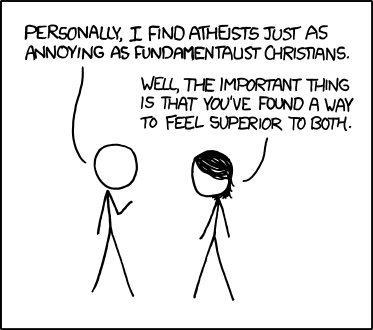
To be somewhat "fair" to the agnostics, I suspect that many of them really aren't relativists. It's probably more like what the classic XKCD comic suggests — they are trying to make themselves feel superior by trying to make themselves sound like they hold an intellectually superior position. This, though, is probably even worse than holding a relativist view. Because it's snobbish. And dishonest. I'll take an opponent who holds an intellectually bankrupt position any day over a dishonest snob who pretends to be intellectually superior.


UPDATE: Two things. One, I may be overstating my case. Slightly. These agnostics may not necessarily be relativists, but they may still be close enough. At the very least, they may not have a good understanding of how we do discover what is true. Or, perhaps they don't think the scientific method or other methods of empirical observation are good methods for finding truth. Still, this really doesn't make things better. Two, I should have said that if someone makes a claim about their god that flies in the face of what we know about the world, they had better present a lot of evidence to back up their claim! It could be that what we think we know is actually wrong.

* Alternatively, if they are going to tell me I can't reject such a god concept because I can't reject this generic universe-creating god concept, then that's just stupid. It's a different claim, despite the similarities it may have with the generic concept.

** Disclaimer: I hope it is clear that I'm not out to criticize all people who label themselves agnostics. I'm only out to criticize those who have the views as described.

Tuesday, September 10, 2013

Know thine enemy. And their arguments.

I, as I would think many liberals do, get irritated when conservatives accuse us of believing X, Y, and Z when we don't. Likewise, I get a bit irritated when liberals accuse those who are more conservative of believing things they don't actually believe. Such often seems to be the case with liberal Christians misrepresenting the beliefs of the more conservative Christians. Below is a clip of Australian Prime Minister Kevin Rudd addressing a pastor in what is apparently a Q&A session. I'm embedding the video from The Last Word as that is where I first saw the actual video (I had read about it earlier at Pharyngula). Lawrence O'Donnell finds the response "brilliant." From a political perspective, yeah, he's been getting good press from what I've seen, so it's probably working out for him. But from a perspective of making a good argument, it is not impressive. I'll go more into Rudd's remarks from the video below the fold. First, I'll address how they misrepresent his opponents position. Then further below I'll cover other problems with his remarks. (The clip I'm interested in starts around 40 seconds in if you'd like to skip ahead.)

Visit NBCNews.com for breaking news, world news, and news about the economy

Tuesday, August 20, 2013

A point of honesty in regards to dragons.

In my last post, I discussed a rather horrible response to Carl Sagan's dragon example. Now, in that response, the apologist was essentially addressing two questions at once — one about his god belief in regards to the example and a second about proof for this god. In my post, I indicated that Sagan's example isn't looking for the type of "proof" this author was suggesting. I must now admit that isn't fully true.

Sagan's examples are really a starting point for investigating the dragon. If someone had merely visually seen the dragon, that would not have been enough to say, "Yep, that's a dragon alright!" Maybe it's actually a robot made to look like a dragon. Maybe it's a holographic projection. What we do get, though, is a starting point where we can say, "Yes, there is certainly something here that we can investigate!" It would seem the apologist should agree that there is a starting point*; he has written a book that is supposed to "cover...the evidence for God from science."

So why not include some of these things? Well, for starters, the person the apologist is addressing is an atheist who has already expressed that they were not impressed by the apologist's work. But, also, the apologist may already suspect the atheist won't even agree on those starting points. If the apologist's arguments are anything like "DNA is a message!" then there likely won't be agreement. Better to dismiss the argument entirely than entertain an argument you know won't fly.


* This is the actual reason his "list...of things which certainly do not exist" is bollocks. We can, for the most part, agree that there are things there that can be investigated, even if such investigations are challenging.

Friday, August 9, 2013

Responding to "The Dragon In My Garage" by...not actually responding.

I was just Googling Carl Sagan's The Dragon In My Garage and found a post with a Christian response on the topic. The response was requested by an atheist who apparently has read some of this apologist's other work. We'll go through it piece by piece in a bit. First, the low-down on Sagan's Dragon:

Monday, October 29, 2012

Theologians Respond! ...Laughably.

   I've seen some theologians respond to Mourdock's comments about rape. They have been mostly laughable from my perspective. Let's take a look at some...

From CNN...
Rabbi Harold Kushner, author of the best-selling book “When Bad Things Happen to Good People,” said Mourdock’s remarks were off-base: “He’s invoking the will of God where it is not appropriate."
What does that mean...not appropriate? Better yet, when is it appropriate? This goes with many of the points I made in my post. It seems perfectly acceptable to "invoke the will of God" when good things happen or in regards to the survivors of a tragedy. But when bad things happen or in regards to those who died in the very same tragedy? Not appropriate!!! That is how I read this quote; it's not that Mourdock was wrong but rather that Mourdock violated the first rule of Fight Club (which is to not talk about Fight Club).

People “should have compassion for the person whose life is messed up by this and not make her an instrument for our idiosyncratic, theological commitment,” Kushner said.
Again, it still feels that this Rabbi is not disagreeing with Mourdock as much as thinks Mourdock needs to shut up.

“If you believe she has no right to terminate that pregnancy, you're free to believe that,” Kushner said. “But for you to write your preferences into law and compel another person to mess her life up because of what you believe, I think you're going too far.”
This is one of those quotes that really bothers me. Of course he's supposed to try to write this stuff into law! What is the purpose of laws, after all, if not to give or ban certain rights? I believe that no one has the right to own slaves. Should we not have this written into our laws? The real issue here is that this belief stems purely from Mourdock's religious beliefs. He has no good non-religious reasons for writing this into law, which, as a secular nation, is supposed to be par for the course.

"Once again, expressions of Christian faith that honor the rights of women to choose their own health care options and what happens to their bodies are not seen or heard," wrote the Rev. Barbara Kershner Daniel.
Yeah, and do you want to know why? Because the people who are honoring the rights of women are doing so not because their Christianity dictates it but because they are people who care about the rights of others. Get it? Mourdock's beliefs stem directly from his Christian beliefs. The beliefs of these other Christians do not. I will concede, however, that not all denominations of Christianity dictate the beliefs that Mourdock has.

Father Tom Reese, a senior fellow at the Woodstock Theological Center at Georgetown University, said he found Mourdock’s comments troubling from a Catholic perspective because “God does not want rape to happen.”
Hey, didn't we recently see someone else say we shouldn't be "invoking the will of God"...or something? Oh, but that's right! That comment was about doing it when it was "inappropriate." Yet, this goes to my point that it's fine to invoke this will when it has a positive feel to it.

“Someone getting pregnant through rape simply means biology continues to function,” Reese said. “That doesn’t mean God wills it.
I completely agree! But then you don't get to say that "God wills it" in regards to someone getting pregnant through consensual sex. What bothers me is how it's biology, except when it isn't. By which I mean it seems very convenient that it is biology only when it is inconvenient to be the "will of God." To be fair, I don't know if this particular person believes it to not be biology otherwise, but I do get such impressions from other people.

“If we look at the Scriptures, we see a God who weeps with those going through pain, who is compassionate for those who suffer and condemns those who do injustice,” Reese said.
I saw pretty much the same comment from another theologian on Raw Story (posted later below). Some of the reaction there amounted to, "Umm... have you read your Bible?" I would assume this person has. I grant that you can find parts in the Bible that sound much like this (probably without the weeping deity, though). There are a lot of parts that portray much the opposite, especially in the Old Testament. The New Testament is more mixed. In one passage, you may have a Jesus who seems to care about helping people. The next? A Jesus who threatens people with hell mobster style! (In other words, the threats are indirect. A mobster may threaten someone's family by saying, "That's a nice family you have there. It'd be a shame if something happened to them!" Such indirectness has, unfortunately, made it easier for Christians to deny that such threats exist.)

Paul Root Wolpe, the director for the Center of Ethics at Emory University, said Mourdock’s comments were the equivalent “of saying you shouldn't pull people out of the rubble because God intended the earthquake to happen or we shouldn't try to cure disease because it's God who gave us the disease,” Wolpe said.
First, where, exactly, was Mourdock saying we shouldn't help rape victims? He was just saying that they have to keep any pregnancies that may result. Maybe (I doubt it, but maybe) he's all for providing them with some financial assistance while they go through the pregnancy and perhaps afterward as well if they decide to raise the child themselves? I see what he is trying to do with these analogies, but they don't fit. Second, notice that he isn't denying that his god intends earthquakes, disease, and (probably) rape.

[Mike Deeg, the pastor of Mourdock's church] said of what he has read about Mourdock’s remarks, they largely lined up with the church’s teachings on the sanctity of life and their belief that life begins at conception.

“I think rape is a horrible thing, and I think God would condemn rape as horrible,” Deeg said. “I think we’re made in the image of God regardless,” he added, “I don’t think the circumstances dictate whether God knows us and loves us, regardless of how our conception comes about.”
He agrees with Mourdock. Color me shocked! (not)

And just an extra, since it stuck out...
[John] South, the chaplain in Phoenix, said the 12-year-old girl he met years ago opted for an abortion and her father was ultimately convicted of rape. He said he grappled often with “why she was subjected to such horrendous pain and torture, mentally, physically and emotionally.”

“Did it shake my faith? No,” South said. “Did I ask God why? Of course.”
Did you get an answer?

So let's recap. What did our theologians/rabbis/pastors actually say in regards to Mourdock (paraphrasing)?

Rabbi Harold Kushner - "Don't talk about it!" Doesn't say Mourdock is wrong. Sure, doesn't say Mourdock is right, either, but he sure blew an opportunity if he does disagree.
Father Tom Reese - "God doesn't intend rape!" But Mourdock didn't say that about the rape. He said it about the pregnancy. People have inferred that means the rape must be intended as well. I disagree.
- "Pregnancy from rape is biological!" This one addresses what Mourdock actually said and shows clear disagreement. But what are his thoughts toward pregnancies that are from consensual sex? Are there inconsistencies?
Paul Root Wolpe - "We help people who are in crisis!" Mourdock never said we don't; doesn't address issue.
Pastor Mike Degg - "Yep, everything he said we teach in my church!" Proud pastor!

Out of all those quotes in that post, we found merely one paragraph that actually countered what Mourdock said. Everything else either agrees with Mourdock (Degg), dances around the question (Kushner, South), or answers the wrong questions (Reese's first quote, Wolpe).


From Christian Science Monitor (via Raw Story)...
What Mourdock said “is offensive,” says Richard Lints, a theologian of the Reformed tradition... “The clumsiness is [to] so align God with evil that God becomes a horrific figure. It’s contrary to anything you read in scripture, and it removes the human responsibility.”
This is the quote I referenced above that had an "Umm... have you read your Bible?" reaction. Of course he has, but I would guess he's aiming for an audience that hasn't...unless he has actually convinced himself that what he speaks of the Bible is true.

“The Calvinist would say God has permitted [bad] things to happen” because humans have free agency, says Gary Scott Smith, a Presbyterian minister and historian at Grove City College in Grove City, Pa. “But we should not attribute [evil things] to God, even though God can bring good things out of them.”
This is the more interesting one. It's on the verge of being contradictory, if not so. The issue is that the free will defense* is used to explain why bad things happen. But, to be consistent, it should be all-or-nothing. Either this god does get involved in things both good and bad or not at all. The way this is stated, I get the impression from the "God can bring good things out of them" remark that this god can be involved, but this involvement is one-sided. Now, this is a Presbyterian minister talking about Calvinist beliefs, so perhaps he is not agreeing with the free will defense. But then how is he justifying this point about how "we should not attribute [evil things] to God"?

Moreover, there is nothing here that is in disagreement with what Mourdock said. This appears to be addressing the rape. Again, Mourdock said the pregnancy, not the rape, was intended by his god. The pregnancy could be viewed by someone like Mourdock as a "good thing" brought out of the rape.

Here's one I like...
What’s more, some also worry that “if you start restricting the scope of providence, that’s a slippery slope to atheism,” says [Peter] Thuesen, a professor of religious studies at Indiana University-Purdue University Indianapolis. “It calls into question whether there really is a God who controls all things.”
He appears to be saying that if you apply this god's care or intervention with a limited scope, this could lead to a lack of belief. I somewhat agree, mostly if people would actually sit down and think about their beliefs. But I find that a lot of people already do limit that scope, which was much the point to my first post on this Mourdock topic. Yet, they're not atheists.

This confuses me, though. Can someone explain?
Mourdock isn’t part of any obscure sect. He reportedly attends Christian Fellowship Church in Evansville, Ind. It’s a “fairly typical Evangelical megachurch,” not a hub of fringe theology, according to Larry Eskridge, associate director of the Institute for the Study of American Evangelicals at Wheaton College in Illinois. Insofar as Mourdock seeks to emphasize God’s sovereignty in all things, he belongs to a “vocal minority subculture” in the United States, Thuesen says.
So...he isn't part of any obscure sect...but...he belongs to a "vocal minority" all at the same time. Yes, yes, I see the "insofar" which is limiting the topic, but why doesn't the rest of this sect share his view? We have quotes from the pastor from the previous link in agreement with Mourdock, after all. Or do they share this view, but are just not vocal about it?

Summarizing this link, we once again have theologians who aren't clearly saying Mourdock is wrong. Or where they appear to be doing so, they are once again either misrepresenting their scripture or referring to the rape itself, which Mourdock never said was intended.

Which all goes to the point I was making in my earlier post that nothing Mourdock said was wrong theologically.

* For those who are unfamiliar, the idea is that this god does not intervene in human affairs because allowing us free will is preferred to stopping bad things from happening. But this means this god is supposed to stay out of causing good things to happen as well. I find it to be a problematic defense for Christianity largely because there are many stories that have their god intervening. Also, many Christians don't believe in it. If they did, then they wouldn't have believed that their god was responsible for the Denver Broncos winning football games with Tim Tebow as quarterback.

Wednesday, October 24, 2012

It's consitent, not outrageous.

   I've discussed in the past a bit about inconsistencies in liberal* Christianity and I'm finding I need to discuss it again as some news items have been causing me to facepalm.

Monday, September 10, 2012

Christians and the Death Penalty - The New Testament reaffirms the Old.

   I recently wrote how Christian scriptures support the death penalty, but my reasoning came from the Old Testament. While that really should not matter, many Christians claim it does...something about how God was wrathful then, but things are better now. Why? 'Cause Jesus, that's why! So are things really better now? No. Why? 'Cause Jesus, that's why!

   I've seen this idea discussed many times before (so here I am, being slow in the head again), but most recently I saw it in a discussion about how Christianity actually glorifies torture.
[Stephen] Pinker discusses graphically what the Christian idea of the crucifixion really means and invites us to consider how sincere belief in this idea would inform a person's worldview:

"In allowing the crucifixion to take place, God did the world an incalculable favor. Though infinitely powerful, compassionate, and wise, he could think of no other way to reprieve humanity from punishment for its sins (in particular, for the sin of being descended from a couple who had disobeyed him) then to allow an innocent man (his son no less) to be impaled through the limbs and slowly suffocate in agony. By acknowledging that this sadistic murder was a gift of divine mercy, people could earn eternal life. And if they failed to see the logic in all this, their flesh would be seared by fire for all eternity." [p.14]

In the early medieval eras, Christians wrote martyrologies that described the torture and execution of saints with "pornographic relish" [p.14]. For example, Pinker quotes a Christian poet named Prudentius who wrote of a believer watching her son be roasted alive: "[She] showed no signs of grief, rejoicing rather each time the pan hissing hot above the olive wood roasted and scorched her child." [p.15] Other martyrologies praised saints who were variously crucified, impaled, sawn in half, crushed, stoned, beheaded, disemboweled, or broken on the wheel (in which a person was tied to a wagon wheel, their arms and legs smashed with hammers, and then left to slowly die of internal hemorrhage).
   The part in bold font is the most important. Here we have the idea that the best way (it must be the best, because the idea came from on high) to deal with crime (sin) is to execute a person, and someone who is said to not even be guilty of a crime, no less! Now, does this mean that it is then OK to kill someone who is guilty of a crime? I must admit that the logic does not clearly follow, but there isn't anything here to counter the logic of the Old Testament. Fortunately, we have grown somewhat out of that horrible moral state. But, as I said before (in the update), "The problem that religion causes is that it shuts down the debate." Or at least it tries and it certainly stagnates progress.


   I also cannot help but notice that the excuses for why abortion is wrong is because that is "innocent" life. Hmmmm... innocent like Jesus? But it was OK for Jesus to die! The response to that is bound to be that the crime Jesus died for is paid in full, so innocent life after Jesus does not need be put to death.

Ken Ham: A clock that's correct twice a day is better than a clock that is never correct!

(via Pharyngula)

   Ken Ham has some of the dumbest arguments, I often don't know whether to laugh or cry. This week, the argument is essentially because science has changed, and the Bible hasn't, the Bible is more reliable.
An evolutionist could look at this chart and say, "See, scientists are continually studying the data and refining their answers, so we now have the age of the earth and dinosaurs narrowed down." We agree that scientists should continually refine their views as new information becomes available, but that is precisely the problem when it comes to this topic. Evolutionary scientists have changed "common knowledge" multiple times over the past century, yet the Bible has not changed. It still clearly teaches that the universe, earth, and dinosaurs were made during a six-day period about 4,000 years before Christ.
PZ Myers has a more thorough breakdown that I recommend reading, but this got me thinking about how even a broken clock is correct twice a day (assuming we are using 12-hour time). What is often not pointed out is how a working clock may never be correct! Think about it — if I have a clock that keeps perfect* time, but it is a minute off from the actual time, it will always be off by a minute. So which clock would you rather have? The one that's correct twice a day or the one that's never correct?

   Of course, my analogy is flawed. The Bible is just flat out wrong on the issue of the age of the earth (it's not and is never correct) and science works at getting closer to the correct answer. Yet, the larger point I am trying to make is that I'm not going to go with a source just because it may happen to be right once in a while nor because it is consistent/unchanging. If it is a choice between a source that randomly guesses and a source that does actual investigative work to influence its guesses, I'm going with the source that investigates even if the former is correct more often than the later.

* Which isn't really a thing...time is relative. But maybe one could say "perfect relative to the location"? All else I'll say is I didn't want to dive into the philosophy of time on this post.

Monday, August 27, 2012

Oh, of course!!! (A lightbulb turns on! (Or, the dots finally connect!))

   Medium story short* — I began working on a post about abortion and, in particular, was working on the inconsistency seen with people calling themselves "pro-life" being in favor of capital punishment (the death penalty). In researching, I quickly found a number of sites (such as this one) that essentially say it is OK to kill life that is not "innocent." Then it hit me...

   I wrote in a recent post how biblical stories such as Noah's Ark are problematic because they lead to the conclusion that killing wicked people is OK when you also include the belief that the god in the story is a good god. The logic, since I did not lay it out there, is as follows:
  1. God is good.
  2. God kills wicked people.
  3. Therefore, killing wicked people is good.
   As I implied in that post, all you then have to do is add in a declaration that a certain group of people are wicked and you have successfully created a justification for killing them. I have for quite some time how this logic could be used to justify killing non-Christians or homosexuals...why I didn't make the connection between this and the death penalty sooner is beyond me. In this case, it is primarily people who have been convicted of murder** that are labeled "wicked."

   So when you see all those good Christians championing the death penalty, they are not misrepresenting*** Christianity; they are taking its moral lessons to heart.


* What? It's not a long story, so why would I call it that? :)

** And that's just based on the present state of the justice system in the USA. Go further into the past or to other predominantly Christian nations (Uganda, anyone?) and you'll see the Christian "love" spread to lesser "criminals."

*** I have a couple of points to note: One, as mentioned in that post referenced above, "some Christians ignore or overlook the horrible parts of their scripture." I'm very glad that they do. At the same time, those same Christians often try to claim that those morally reprehensible Christians are simply misrepresenting Christianity. Just because the later ignores the "love your neighbor" parts does not make them any less "Christian" than the former who ignore the many cruel parts of the Bible. And I get tired of hearing such poor excuses.


UPDATE: Thinking about this further, I realize why I overlooked this. Punishing cheaters (criminals) is necessary for a society to function. Punishing people for being part of a certain ethnic group or for having a certain sexual preference is not. In other words, when it comes to criminals, determining what is proper punishment is at least an applicable debate. The problem that religion causes is that it shuts down that debate. The religious think they have had the answer provided from on high. But what they really have is a moral system that is 1900+ years out-of-date.

   Also, had I really not heard of the phrase "An eye for an eye" before? Seriously!!! That is just more reason I should have been making this connection sooner! /UPDATE

Wednesday, August 22, 2012

Protecting religion is a problem.

   In a previous post, I discussed how religion is unnecessary at best. This time, I want to discuss the social problems I see that amplify the negative parts of religion.

   In that last post, I mentioned the story of Noah's Ark, in which Yahweh commits mass murder because people are wicked and how it can be concluded that killing wicked people is good. Then all you have to do is declare a group of people (Jews, gays, atheists, Muslims, etc.) to be wicked to justify killing them. What I had not discussed is how this story is told to children. Now I realize many children are not going to draw the conclusion that killing wicked people is acceptable; they are going to be much more interested in the pretty animals on the big boat. And likely the adults telling them the story are going to focus on those aspects as well. But the fact that a justification for killing people is present in the story is still a problem as someone can potentially pick up on it, even if it is a small percentage of people who do.

   To be blunt (and to take the focus off of Christianity), the biggest problem with religion is that it is often authoritarian. If someone thinks their god(s) wants something, then they'll likely do what they think their god(s) wants! This can be very beneficial if they think their god(s) want them to do good things...give to charity, treat people equally, etc. However, beliefs like this can have an equal impact if and when they think their god(s) want them to do bad things, like kill supposedly wicked people. And, as I have been implying, they think these bad things are actually good because they believe their god(s) to be good. Thus anything that god(s) wants is also good. (See also: The Holy Hair Dryer)

   The reason, then, that protecting religion becomes a problem is because people don't generally need justification to do things that are actually good. Someone can attribute their desire for giving to charity, treating people equally, etc. to a god(s) all they want, but they will be praised regardless. In other words, such people will be respected for doing good. Period. Invoking religion is unnecessary. On the other hand, people do need justification for doing things that are bad. This is because many people will condemn them for doing their misdeeds. When you then have a society that embraces religion, using religion as a justification, whether or not that is truly the reason, for misdeeds becomes an open path.

   On that, many of the excuses to defend religion are quite pathetic. The most common that I see is the one I eluded to in that previous post. It is the idea that the bad people are a small minority and/or that those people "misrepresent" religion. Being blunt once more — No, they don't "misrepresent" religion. As I implied above, religion can be many things. Just because one person attributes religion to good things does not mean the next person cannot attribute it to bad things...especially when the scriptures for the religion promote cruelty, as in the Noah's Ark example. Another way to say this is that there is no objective*, or correct, approach to religion. After all (bluntness alert!), there is no good reason to believe the gods that any religion promotes actually exist and there is much more reason to believe religion is all made up. People are then free to make up the way in which they want to follow the religion. Therefore, religion can be whatever anyone wants it to be. They have free range to make additional shit up. To then suggest that someone using that free range to cause harm is somehow misusing or misrepresenting religion is absurd.

   Of course, defenders of religion don't notice this absurdity. Why? I suspect it is because they think religion should be one way — theirs! They have this idea of what they think religion should be instead of what it really is. And it is then the idea of what they think religion should be that they defend as opposed to defending reality. This, perhaps more than anything I have already mentioned, is the largest problem with protecting religion — people are not trying to protecting religion as it really is, but rather their fantastical idea of religion. Since that fantastical idea doesn't actually permeate outside their minds, what they end up defending is religion as it actually is...which should not be defended.

* There are perhaps points where one can deviate so much from what is in the scripture of a religion that, even though it would still be subjective, a consensus could be reached that a religious view does indeed "misrepresent" the core religion. An example of this could be Mormonism, particularly if that religion had no additional scripts to explain itself. At the same time, Mormonism is also a great example that shows — if one's views begin to stray too far from the core religion — it is possible to write additional scriptures to justify a large deviation.

Saturday, August 18, 2012

Religion is an unnecessary addition at best.

UPDATE: I noticed that in the morality sections, I address Christianity specifically as opposed to religion in general. I'm writing a related post that will somewhat readdress this topic to correct my error. /UPDATE

   Defenders of faith* will often attempt to make people like me who speak out against religion feel like victims of confirmation bias. They suggest that we are judging all of religion by counting all the bad people who are religious and ignoring all the good people who are religious. As someone who considers myself to be decent at critical thinking, I would typically appreciate such sentiments. The problem here is that, first, this is not a case of confirmation bias and, second, the defenders of faith are not critically examining whether or not it is actually true that people like me are guilty of confirmation bias. To state this another way, they are calling out what could be a fallacy without doing any investigative work themselves. It is not only intellectually lazy, I fear it is often meant to be intellectually dishonest; I suspect they are using this to distract or escape from the discussion. So since the defenders of faith are leaving the grunt work up to me, I'm here today to share my thoughts on why I am not guilty of confirmation bias.

* These people could also be called "religious apologists." Additionally, they are not limited to theists. This could also include atheists who have the belief that religion is useful.

Monday, February 27, 2012

Clinging to minor points

   One thing that I have occasionally noticed in dealing with religious people is they will cling on to minor trivialities. The purpose of this seems to avoid discussing the major point, which I suspect to be an area of discomfort for the believer.
   One of the first times I noticed this occurred nearly two years ago now. In the discussion, I brought up a point made by Julia Sweeney where she observed that a common tactic cults use is to get people to abandon their families and what do you know?!? There is a verse in the New Testament where Jesus tells his followers they need to abandon their families to follow him. The Julia Sweeney quote is as follows:
In Luke, Chapter 14, Jesus says, "Anyone who comes to me and does not hate father and mother, brothers and sisters, wife and children cannot be my disciple."
I mean, isn't that what cults do? Get you to reject your family in order to inculcate you?
   The Christian that I was having the discussion with, instead of addressing the main point, drug the conversation over to whether or not that translation was correct. He wanted the translation to be "love less" instead of "hate". It baffled me why he was so insistent on that, and I admit I failed to keep the conversation under control after that. He eventually claimed I was closed minded for not accepting the translation he wanted. That stunned me, too. I really didn't care one way or the other about the translation because I failed to see how it changed the main point. About the only difference that word change would make that I could see would be to change the emotional overtones, but such a change would not void my point.
   As far as why I bring this up now is because I saw a similar example within the last week. Cenk Uyger of The Young Turks went on a rant mocking the Mormon church for baptizing Anne Frank. See the video here.
   At the time I viewed this video, one of the top comments (though not very highly rated) was from someone claiming to be a Mormon and they said they had lost respect for Uyger for suggesting that the Mormons chant when performing baptisms, pointing out they must have missed that memo (or lesson...I can't remember the exact word used). But if you watch the video, Uyger himself admits shortly after he made his mocking chanting noises that he didn't know if the Mormons actually chanted and pointed out that it didn't matter. The important point was that the Mormons baptize dead people and that is loony.
   Yet, the commenter decided to focus on this suggestion that Mormons chant when performing baptisms. I could understand if they felt offended that Uyger mocked their religion, and that's probably the real reason the commenter had "lost respect," but this was not given as the reason. Instead, the commenter attacked those remarks as if they had been reported as fact.
   The last thing I wish to say before closing is that I'm not sure the believers even recognize when they are making much ado about nothing. I suspect they are just grasping for straws, so to speak, seeking out any point of disagreement on which they can object. Their problem is that the points they find are minor to the point of being insignificant. Yet, they have to defend their faith, so defend it they will, even if the only person who can be convinced of that defense is themself and they make fools of themselves to everyone else.
   To the skeptics reading this, if you see a theist attempting to distract away from your main point by objecting to trivialities, call them out on it and do so quickly. You can do so politely by asking them to explain how that changes the main point or you could be blunt. But if you don't call them out, they'll think you to be the fool. To the theists reading this, if you can't object to the main point, then consider conceding that point. Objecting to trivialities only makes you look like a fool, as well as verifying to the skeptic the stupidity of religion.


   Before I got around to finalizing this for posting, I encountered a similar example today. This time in politics. I stumbled mid-conversation on a comment board and the discussion was about oil subsidies. One of the people in the discussion was claiming that the oil industry does not get subsidies; they get tax incentives, which this person claimed are different. The poster referenced some conservative blog for the definition that defined a subsidy as a direct payment. As tax incentives are not direct payments, then they can't be subsidies. The implication of this seemed to be that one can then ignore anyone who suggests that the oil industry no longer receive subsidies because they have revealed themselves to be uninformed on the issue, thus making their perspective invalid.
   The problem here is that many people do not use such a strict definition of the word "subsidy." In fact, if you Google the definition, you will likely find that many definitions do not say a subsidy has to be a direct payment. Therefore, if a subsidy can be an indirect payment, then a tax incentive can count as a subsidy.
   Once again, as with the religious arguments, we have someone who likely does not want to defend their position fairly, so they make a deal out of smaller points; in this case, the poster made an issue out of semantics. Much like how the Christian insisted that people use his translation of the Bible, this poster appeared insistent that people use their definition of "subsidy," ignoring the arguments of those who would dare use a different definition.
   I will add that if this poster wants to personally use a definition of the word "subsidy" that only allows for direct payments, that's fine. As an atheist, I see many people use a definition of the word "atheist" with which I disagree, and I have had to correct people many times, so I can appreciate arguing for better definitions of words. What I and this commenter do not get to do, though, is expect or insist that everyone else use that definition and dismiss the arguments of anyone who does not use our personal definitions. We must argue from what we understand their meaning of the word to be and must ask for clarification if that meaning cannot be determined.

Saturday, February 4, 2012

Pascal's Wager

This is a supplementary post of my breakdown of the book "I Don't Have Enough Faith to Be an Atheist." Related posts can be found by clicking here.

   Pascal's Wager is often presented to atheists by Christians (even if the don't know there is a name for it). It's a lousy argument for belief. The basics of the argument are as follows:
Pascal's Wager...is a suggestion posed by...Blaise Pascal that since the existence of God cannot be proved (or disproved) through reason, but since in his view there was much to be gained from wagering that God exists (and little to be gained from wagering that God doesn't exist), a rational person should simply wager that God exists (and live accordingly).
And the logic breaks down as follows:
  1. "God is, or He is not"
  2. A Game is being played... where heads or tails will turn up.
  3. According to reason, you can defend neither of the propositions.
  4. You must wager. (It's not optional.)
  5. Let us weigh the gain and the loss in wagering that God is. Let us estimate these two chances. If you gain, you gain all; if you lose, you lose nothing.
  6. Wager, then, without hesitation that He is. (...) There is here an infinity of an infinitely happy life to gain, a chance of gain against a finite number of chances of loss, and what you stake is finite. And so our proposition is of infinite force, when there is the finite to stake in a game where there are equal risks of gain and of loss, and the infinite to gain.
   I can go ahead and grant the first four premises for the sake of argument, as it is the fifth premise that is deeply flawed. Pascal is assuming that, if God exists, (1) you will be rewarded with an infinite afterlife if you wager that God exists and (2) you get nothing if you wager that God does not exist. It is interesting because he claims that God is unknowable, yet he assumes he knows the results for believing. This is absurd. Atheists, therefore, have been known to suggest that if a god exists, it rewards people for being skeptical over being gullible; in other words, there is reward for wagering that God does not exists but not for wagering that God does exist. Just changing that assumption reverses the recommended wager. This is why Pascal's Wager is ultimately useless in regards to the existence of a god.

Friday, February 3, 2012

Face, meet Palm - Of Course Theology Matters!!!

   On Monday, January 30, 2012, Frank Rich, "New York Magazine`s" writer
at large, appeared on the Rachel Maddow Show. He about left me pulling out my hair after some of the stupid things he said. Here is the video for reference (you can skip ahead to at least the 2:00 mark). Below, I'll be covering parts of the transcript that disappointed me.

Visit msnbc.com for breaking news, world news, and news about the economy


MADDOW: You raised some important political questions that could be asked about the Mormon Church during his times as a leader there. Important questions about women in the church, about African Americans in the church, of course, very difficult history in the Mormon Church, being barred from the priesthood on the basis of race, until later than you think that could be possible at a time when Mitt Romney was already a leader in his church.

Is it not just a fear of religious bigotry that people may find his religion objection or strange in some way, by that there are hard political questions that there may be difficult political answer to about his time?

RICH: I think there are. I think the theological questions don`t matter, every religious is entitled to its own theology. And they all have their idiosyncrasies, God knows, only God knows.

But the truth is the Mormon Church has been a player in various things, campaigned against equal rights amendment for women, institutionally, very slow in civil rights. In 1978, that`s how long it took for blacks to get full equality in the Mormon Church.

MADDOW: Wow.

RICH: And then there`s the gay part of it, because we know that the Mormon Church drummed up more than $20 million to put over Proposition 8 in California two years ago. We know -- a few years ago. We know also that 80, 90 percent of the volunteers who organized that juggernaut were Mormons.

So, that`s a big player in an important political issue that affected the law in the state of California. Where was he as a contributor and leader?
   Emphasis mine. Right here...this is what caused me to really blow up. How can Frank Rich not think the theology matters? Do you know why the Mormon Church has been so bad about civil rights? I'll give you a clue: it's eight letters long and starts with a 't'. Yeah, it's because of their theology. Now, I'm not an expert on Mormon theology, but it is my understanding that black people, for example, are black because God has placed a curse on them—I think for some "sin" their ancestors committed years ago—according to Mormon theology. As for women, I've heard there are a number of sexist passages in the Book of Mormon. I don't know what Mormon theology says about gays, but I doubt it has anything kind to say. So, when you know (or at least have a basic understanding of) the theology, these things are not surprising at all. These political actions taken by the Mormon church stem from the theology.

   Furthermore, liberals frustrate the hell out of me when they justify protecting stupid ideas by pointing out that essentially everyone has some stupid unfounded idea, or "idiosyncrasies" in this case. Whenever I see such statements, I read them as "I don't like having my beliefs challenged, so I won't challenge yours." The somewhat odd thing about this is that Frank Rich still criticizes the Mormons for acting on their theology, yet claims the theology doesn't matter. This is like saying we need to treat the symptoms of a disease instead of the disease itself. This makes no sense when you have the capability of treating the disease. It makes sense, though, when you realize the liberal Christian is infected with the disease, too, and that the disease is caused by a parasite that prevents the host from discarding the parasite. (For more, see PZ Myer's religion as a parasite analogy.) Take a hint liberal Christians—if you want this bigotry to ever completely go away, you have to criticize the theology that justifies such bigotry.

   Looking through the transcript, I noticed something else I find objectionable: "So, just like sexual orientation, religious orientation, it is a part of your being." Yeah...except people are stuck with their sexual orientation; they can, however, change their religious orientation. Or does Frank Rich think sexual orientation is a choice?

But still that is weird to talk movingly about something that never happened.
   Yes, I find the way people cry over Jesus quite weird! (OK, this comment is off topic, but I had to say it.)

So, they are sort of kidding themselves and I think it would humanize
him to talk about his faith, given his importance to it and its importance
to him, and to be candid about where he agrees, disagrees, not about
theology, not about their view with the Bible, not about Joseph Smith, but
about 20th and 21st century politics in America.
   When I had heard this live, I had interpreted this slightly different. Now I am not sure how to interpret it. I'm curious as to why he's talking about the Bible. Because, I agree there. I don't really care about their view with the Bible! Nor the Koran. Nor the Bhagavad Gita. These are not the Mormon holy book. Their book is called The Book of Mormon. Does Frank Rich not even know what the Mormon holy book is called?!? I find it hard to believe he is that ignorant...but, then again...

   At any rate, in regards to Mitt Romney, it is important to know where he stands on Mormon theology and whatnot. Again, it's because the theology influences people's actions. So, if we know what Romney thinks about the theology, we can then better predict his actions as President. If Romney agrees with much of Mormon theology, then we have a problem. Furthermore, if Romney's view of "20th and 21st century politics" includes that there should not be a separation of church and state, then this becomes a serious problem.

Wednesday, February 1, 2012

Can you name all the fallacious arguments in this video?

I found this video in my list of recommendations. Watch it for yourself, and see if you can find all the flaws. I'll reveal what I found below the fold. If anyone sees any that I missed, let me know in the comments!


0:46 — "I'm not an astronomer; I'm a theologian."
He appears to be humbling himself. Watch for him to later boast about the intelligence of other people later one to set up a "Look at how this dumb theologian outsmarted all those intellectual elites!" argument from authority.

1:00 — "I want your guy—your astronomer to go first."
He wants to be able to ask the astronomer questions, but not the other way around. It may be that he is trying to dodge any uncomfortable questions, using the "I'm just a dumb theologian" excuse as his cop out. Turns out to not matter anyway as the astronomer can't attend.

1:48 — Something about Romania dying in the hard communist area. "I was like the lamb thrown to the wolves."
He's trying to give the impression that he was speaking in front of a bunch of atheists, because communism is often—incorrectly—associated with atheism. (Communism is more anti-church, especially toward church involvement in the State, than atheistic anti-theistic.) The fact is Romania is quite religious today, with Wikipedia reporting that 86.7% of the population identify as Orthodox Christian. This would not have been the hostile territory he claims (unless huge chunks of the population converted because of his presentation...yeah, I doubt that). Again, I am suspicious about this being part of a setup for an argument from authority.

2:30 — "You know the Bible says that God will give you answers you've never thought about before."
I smell bullshit. By which I mean I suspect him of blatantly lying here. It depends on what the argument is. If it's one I've heard before, then likely this claim is total bullshit. (You could argue that if I've heard the argument before, it's because the people I heard it from got it from this guy...or the chain of people it went through leads back to this guy...you get the idea. Or maybe the argument is older, but he'd never heard of it. It's possible, but my experience with apologetic theologians is that many of them have pretty much the same arguments, probably due to borrowing from each other.)

2:46 — "This is one of the most prestigious universities..."
Yep, here comes the boasting.

3:10 - 5:15 — Argument summary: The knowledge base of even the smartest people on earth is really tiny. God could just be outside that knowledge base.
This argument is a prime example of the argument from ignorance. The argument is essentially saying, "You don't know enough to disprove God!" (Or, at the minimum, "You don't know enough to say God doesn't exist!") If you don't understand why this is a fallacy, the problem is this argument can be used to justify just about anything!For more, see my post on what's possible.

5:16 - 6:40 — Two alternatives summary: one is you live and you die, second is there is a loving god who takes care of you, especially in the afterlife.
Once again, the fallacy is made blatantly obvious to those who know their fallacies. This is the false dichotomy. Why do those have to be the two choices? What about a third choice? Maybe there is a God, and he does indeed have happiness awaiting for me...like say 72 virgins (Islam) that will do my bidding. Plus, I get to have an awesomely ripped physique...and, yes, a huge penis. (And for the women, gays, bisexuals, etc, you get whatever it is you want for sexual pleasure.) Maybe I can get my own planet to rule over (Mormonism)! In short, it's the ultimate fantasy land* (and if you're not big into sex, I'm sure there could be something else nice waiting for you). If I had that as a third option, guess which one I'm going to choose? Yeah, that third one. This is, of course, why he is sure to stress that these are to be your only two options. His argument (for Christianity) clearly breaks down once you start allowing for more choices.

* Joking aside, the point is that I can (1) imagine an afterlife more appealing than the Christian version and (2) there are other religions already in existence that have a more appealing afterlife!

Now, I also have some issue with his hypothetical in saying "if they are both believable" (6:06, 6:34, more). Well, what makes them believable? Are they believable simply because they could be outside our knowledge (his previous point)? They can't both be believable based on supporting evidence, since they contradict each other so much! So, if ignorance is what makes them believable, then we have a lot of options to choose from, as I pointed out in the last paragraph.

His objective, though, is most likely to get people to investigate into whether or not Christianity is actually believable. (Evidence to support this is found later at 7:06 in which he says to the audience "So what you really are is seekers.") This is also why he must limit your options to two; he doesn't want you to go out and investigate those other religions! You are to only investigate Christianity! If you don't, you might find reasons to find those non-Christian religions "believable," too.

The next point I have to make is I found it interesting that he noted (5:43) the problem of evil in his second choice, but brushes is aside like it's no big deal. Then again, when you promote ignorance itself as being no big deal, this becomes relatively easy.

For my final point, he suggests that atheists—since the first choice is obviously supposed to represent atheism—don't understand pain and suffering (6:10). Sorry, the problem of evil does not apply to atheists. It's easier to understand pain and suffering when you realize we live in, though this is an oversimplification, a dog-eat-dog world. Furthermore, I'm not going through life alone (6:14); I have family and friends. I'm doing just fine, thank you. (He may mean alone as in "without God," but that would mean he's presuming his second option is already the desirable option, which makes this an unfair choice.) The whole point here—and likewise with option two being a "loving god"—is to make an appeal to emotion, making the first option as undesirable as possible while making the second option sound quite appealing.

6:44 — "...because an atheist says, 'I know God doesn't exist'"
Face, meet Palm. I get tired of correcting theologians on their straw man. I'll just direct you here.

6:59 — "...because an agnostic says 'God may not exist, but I don't even care if he does or he doesn't.'"
Actually, that describes an apatheist. I'll grant him that I've seen a number of apatheists declare themselves to be agnostics, though. (Which may be an indicator that they care juuuuust enough to where they don't want other people to think of them as someone who doesn't care.) At any rate, an agnostic is someone who thinks a deity is unknowable. In practical terms, this can even just be an admission of having an insufficient knowledge base. Again, I'll direct you here.


The rest of the video is basically just preaching...and impressing the audience with how these supposed atheists came up to collect Bibles afterward (assuming that part of the story is true), thus completing his argument from authority. ("My argument was so impressive, it got intelligent atheists to rethink their stance on God!") More importantly, I do want to go back to a question I posed earlier, which would be the one regarding whether or not I've heard the argument before*. I have. Well, particularly the one about God being outside the knowledge we have. I do seriously doubt he was being honest in his claim that he had never thought about that before.

* This one was slightly better formed than when I've heard it previously. There, the argument revolved around the idea of the universe being large. That was just silly; if the person making the argument found reason to believe in God, then I only need to look where they did. And I assure you, they didn't look beyond this planet. So, at least this guy focused only on earth-based knowledge. Ultimately, it's still the same fallacy, but just not to the same degree of absurdity.

So, let's review. How many fallacies did I find?
  1. A veiled argument from authority sprinkled throughout the video.
  2. A blatantly obvious argument from ignorance.
  3. A blatantly obvious false dichotomy.
  4. Typical Christian propaganda that appeals to emotion.
  5. A straw man (misrepresentation) of what atheism and agnostism are.