I was just Googling Carl Sagan's The Dragon In My Garage and found a post with a Christian response on the topic. The response was requested by an atheist who apparently has read some of this apologist's other work. We'll go through it piece by piece in a bit. First, the low-down on Sagan's Dragon:

Friday, August 9, 2013

Thursday, August 8, 2013
Laughing at the stuggles of celebrities and marginalizing those who aren't
I'm just a bit disgusted. I really hate how we as a society love to make a joke out of the personal problems of celebrities. Currently, it's Amanda Bynes. I don't follow celebrity gossip, so I don't really know all what's going on, but apparently she's having problems with drug abuse, somewhat like Lindsay Lohan before her. I was just sitting here trying to work this last Friday and the radio DJ decides to play some clip that makes fun of Bynes' struggles. This clip was essentially a satire of advertisements for charitable organizations for helping people in need. The joke is that Bynes is not in need because she's a rich celebrity. I fail to find it funny, though. Here are probably my biggest two issues with such satire:
- Incidents like this could be used to instead have serious discussions. What particularly comes to my mind is the conservative/libertarian fairy tale that poor people are just lazy (and probably do a lot of drugs) and if they'd just take some responsibility, they'd magically have better lives. Cases like this work as a bit of a counter-narrative, showing that irresponsible people can be wealthy. (Though, those who believe in the myth would likely point out that Bynes' career is going to suffer from all of this. They would be correct, so any conversation would have to focus on a point that the real world isn't as simplistic as conservatives/libertarians make it out to be.)
- What bothers me most, though, is that such satire marginalizes people. Actually, this can be broken up into further sub-bullets.
- I think in such a satirist clip is a criticism of culture. I'm going to start with a different example to explain what I mean. Back not so long ago, I was checking out on YouTube Five Finger Death Punch's video for their new song, "Lift Me Up." In the comments, someone said something about the song being awesome and how they can't understand how such music isn't as popular as Psy's "Gangnam Style." Except...they didn't call the song out by name but rather as a song by a fat Asian. Alright, I can understand and sympathize with not totally getting why such music is so popular. But what the fuck does Psy's weight have to do with anything! It reminds me a bit of a phrase I used to hear a lot a decade or so ago: "Don't hate the player. Hate the game!" And that really seems to be what they hate, with "the game" being analogous with what music is popular in culture. But "the game" can't be marginalized because it is not a person. The player, however is and thus can be.
I suspect something quite similar is going on in the minds of whoever produced this clip on Bynes. They're really trying to make a critique of culture that props up people as celebrity that don't necessarily deserve such a status. It's a point to which I generally agree; in fact, I do find celebrity worship rather stupid and occasionally dangerous (like when a celebrity endorses a harmful product or idea). So when a celebrity struggles with life, these critics use that celebrity's struggles to attempt to make a point. The problem is with how the criticism is made. Essentially, these points are made without recognizing the celebrity as being a human being but instead treating the celebrity as an object in which to use to score points. There is no concern for the state of Amanda Bynes in this clip. In fact, there was the opposite as it mentioned her having "$4 million in her savings account" or something to that effect. In other words, you are not to feel at all sorry for her. Bynes is simply the latest object to use to make points against pop culture. Before her it has been Charlie Sheen and Lindsay Lohan.
And now I realize I made a mistake (which I could remove, but will leave in to show the development of my thoughts). These are not the players; these people are the balls. The game is still the same, but the players, I now realize, are members of society. On one team are those who embrace pop culture and on the other are those who do not. The idols of pop culture, then, are the game balls. - Worse than marginalizing celebrities, though, is the marginalizing of "common folk." I don't have any statistics handy, but it should not be a point up for debate that many people struggle with drug abuse or various psychological problems. When you make fun of a celebrity for struggling with such issues, you are essentially making fun of all people with such issues. This is because you are often making fun of the celebrity through their behavior that results from their struggles. Those behaviors are not limited to the celebrity. A drunk celebrity, for example, can go into a stupor just as much as someone who is not a celebrity. Drugs, alcohol, and whatnot don't have some special effects on celebrities that they don't on other people. If a person struggling with alcohol abuse sees you making fun of a celebrity going into a drunken stupor, what might they think? Is it unreasonable to suggest they might suggest that you would also make fun of them for their drunken stupors??? On that, another point that should not be up for debate is that laughing at people with such problems in no way helps them and may make things worse.
The most common, seemingly legitimate defense I would suspect is something along the lines of, "Oh, but I only intended to make fun of Bynes!" Yeah, well, the road to hell (if there were such a place) is paved with good intentions. Not to mention that making fun of people is never a good intention...but I digress! The point I need to make here is that your intentions don't matter; it is how others interpret your message that matters.
Other "defenses" may be to suggest that these people "develop a sense of humor" or "grow thinker skin." Yeah, well, you could stop being an asshole, too! These are examples of what I am starting to call "shifting the burden of responsibility." It's asking others to change their attitudes so that you may maintain yours. It's dishonest.
- I think in such a satirist clip is a criticism of culture. I'm going to start with a different example to explain what I mean. Back not so long ago, I was checking out on YouTube Five Finger Death Punch's video for their new song, "Lift Me Up." In the comments, someone said something about the song being awesome and how they can't understand how such music isn't as popular as Psy's "Gangnam Style." Except...they didn't call the song out by name but rather as a song by a fat Asian. Alright, I can understand and sympathize with not totally getting why such music is so popular. But what the fuck does Psy's weight have to do with anything! It reminds me a bit of a phrase I used to hear a lot a decade or so ago: "Don't hate the player. Hate the game!" And that really seems to be what they hate, with "the game" being analogous with what music is popular in culture. But "the game" can't be marginalized because it is not a person. The player, however is and thus can be.
Thursday, August 1, 2013
Won't somebody think of the children?!? -- Inconsistency in the anti-abortion movement
This post is going to take a couple different directions. I first want to just briefly mention how British prime minister David Cameron is trying to stop pornography on the internet. And his reason? Think of the children!!! It's rather quite sad when people use children to push a political agenda, but, having said that, there are legitimate cases where it really is about the children.
This gets us to what I originally wanted to write about. My wife has a friend who apparently has been dealing with people who sound like far-right Tea Party folk; people who don't like the government telling them they have to have their children in a car seat. No, I'm sorry, this is not the government telling you what to do. This is one of those legitimate cases of the government thinking of the children. You do not own your children. While they are yours in a caregiver and often biological sense, they are individuals that have rights, and one of those rights is protection against the idiocy of their parents!
And these people should understand this, because I suspect there is a good chance that these people would also be anti-abortion. One of the main arguments such people often use against abortion is that the fetus is a human being that has rights. That should mean that it will still have those rights as a child. Or do we live in a really bizarro world where fetuses are human beings but children are not? Of course — well...to anyone rational person who pays close attention to abortion debates — the truth is that these anti-abortion people don't truly believe the arguments that they put forth. Their reasons for being against abortion could be from a variety of reasons including the totally thoughtless reason of their pastor telling them to be or the true agenda behind anti-abortion movements of controlling people's sex lives. At any rate, when someone who is against abortions tells you it's about human rights but then gripes about child seat laws is full of themselves on at least one of those topics.
This gets us to what I originally wanted to write about. My wife has a friend who apparently has been dealing with people who sound like far-right Tea Party folk; people who don't like the government telling them they have to have their children in a car seat. No, I'm sorry, this is not the government telling you what to do. This is one of those legitimate cases of the government thinking of the children. You do not own your children. While they are yours in a caregiver and often biological sense, they are individuals that have rights, and one of those rights is protection against the idiocy of their parents!
And these people should understand this, because I suspect there is a good chance that these people would also be anti-abortion. One of the main arguments such people often use against abortion is that the fetus is a human being that has rights. That should mean that it will still have those rights as a child. Or do we live in a really bizarro world where fetuses are human beings but children are not? Of course — well...to anyone rational person who pays close attention to abortion debates — the truth is that these anti-abortion people don't truly believe the arguments that they put forth. Their reasons for being against abortion could be from a variety of reasons including the totally thoughtless reason of their pastor telling them to be or the true agenda behind anti-abortion movements of controlling people's sex lives. At any rate, when someone who is against abortions tells you it's about human rights but then gripes about child seat laws is full of themselves on at least one of those topics.
Monday, July 29, 2013
Ahk! The should-have-been-obvious third reasons Libertarians will never have much power.
I recently wrote about two reasons Libertarians will never have much political power. I forget a third.
Right-wing populism in America has always amounted to white identity politics, which is why the only notable libertarian-leaning politicians to generate real excitement among conservative voters have risen to prominence through alliances with racist and nativist movements. Ron Paul's racist newsletters were not incidental to his later success, and it comes as little surprise that a man styling himself a "Southern Avenger" numbers among Rand Paul's top aides.One of the reasons I find this to be true is because libertarian ideas in regards to topics such as charity sound a lot better in theory than in practice and the practice of these ideas benefit those who are more well-to-do and harm those who are not. As people of color tend to be more worse off than white people, libertarian ideas tend to benefit white people. It is no surprise, then, that white supremacist groups can be found to be strong supporters of libertarian-leaning politicians such as the Pauls. But as the white population shrinks, so does the potential voting base. Now, there could come a tipping point to where libertarian ideas will no longer be as advantageous to whites over persons of color, at which time libertarian ideas could become more appealing to persons of color. I suspect that point is well off in the future at this point.
Thursday, July 25, 2013
And now a second reasons Libertarians will never have much power
Just wanted to provide some quick thoughts on Libertarians. They're just so funny sometimes.
The first reason they'll never have much power is because many insist on calling the purity police. To those Libertarians, Ron and Rand Paul are not "True" Libertarians. While I'll agree that neither man fits the mold of what an ideal Libertarian would look like (besides the fact that both are actually members of the Republican party, but they are Republicans who espouse Libertarian concepts), how do these Libertarians (who apparently believe they themselves are pure enough) think they'll ever have a successful political party if they won't accept people into the party for not being pure enough? That's going to limit membership (maybe this is why the Pauls are Republicans?) and, frankly, there is strength in numbers.
And now just yesterday I came across another potential pitfall. A good number of Libertarians probably don't like giving their information out to groups in the name of privacy. Would they be willing to go against this ideology for the sake of the party? Maybe. But if not, that's going to limit the party's ability to raise money and recruit volunteers if Libertarians are unwilling to give the party their contact information.
The first reason they'll never have much power is because many insist on calling the purity police. To those Libertarians, Ron and Rand Paul are not "True" Libertarians. While I'll agree that neither man fits the mold of what an ideal Libertarian would look like (besides the fact that both are actually members of the Republican party, but they are Republicans who espouse Libertarian concepts), how do these Libertarians (who apparently believe they themselves are pure enough) think they'll ever have a successful political party if they won't accept people into the party for not being pure enough? That's going to limit membership (maybe this is why the Pauls are Republicans?) and, frankly, there is strength in numbers.
And now just yesterday I came across another potential pitfall. A good number of Libertarians probably don't like giving their information out to groups in the name of privacy. Would they be willing to go against this ideology for the sake of the party? Maybe. But if not, that's going to limit the party's ability to raise money and recruit volunteers if Libertarians are unwilling to give the party their contact information.
Monday, June 24, 2013
The baseball analogy - just because you aren't perfect doesn't mean further evaluation cannot be made.
In a post from last year, I used an analogy of a broken clock being correct twice a day versus a working clock never being correct in regards to Ken Ham's silly comment that, "Evolutionary scientists have changed 'common knowledge' multiple times over the past century, yet the Bible has not changed." This really should not give the Bible any credibility, but it does in Ham's Bizarro-World where up is down and left is right.
A similar argument I see used against science is that it occasionally gets things wrong, just like {name of field of study or occupation*} occasionally gets things wrong! An analogy I think can be applied to this argument is that of a hitter's batting average (in the sport of baseball...but this argument could be applied to other sports, such as a quarterback's completion percentage (American football) or a basketball player's shot or free throw percentage...basically anything that uses a percentage is best). Would anyone honestly claim that a batter that hits .350 is equal** to a batter that hits .150 all because both occasionally miss hitting the ball now and then? I would seriously hope not!
Now, to be fully honest, science gets things wrong a lot. This is because science has a process for filtering out incorrect ideas. I don't know of any other system that has such a filter. This is what really makes science effective; it's not really about the percentages. The point, though, is how stupid it is to even bring up such points in the first place since the percentages are never even evaluated. Arguments like this are little but simple-minded dismissals of science.
* This can be many things...astrologists, clinical therapists...even faith healers or prayer could be inserted in here. Basically, this can be about anything that does not clearly use the scientific method. (I know, "clearly" is a very vague qualifier, but I must leave this quite vague because I have seen this argument so broadly used.)
** Well...OK, sometimes batters with worse batting averages are considered better if they hit a lot of home runs when they do hit the ball versus someone who hits often but typically only hits singles. This is essentially known as "slugging percentage." For the sake of argument, let's assume all else is equal.
Actually, I've had this post sitting in draft for quite some time. I realized this was still in draft when I heard about people defending "psychic" Sylvia Brown, in regards to her claim that Amanda Berry was dead, because "everyone makes mistakes. Even doctors, lawyers … Psychics." Yeah...because everyone is harping on Brown for not being 100% correct! (sarcasm)
A similar argument I see used against science is that it occasionally gets things wrong, just like {name of field of study or occupation*} occasionally gets things wrong! An analogy I think can be applied to this argument is that of a hitter's batting average (in the sport of baseball...but this argument could be applied to other sports, such as a quarterback's completion percentage (American football) or a basketball player's shot or free throw percentage...basically anything that uses a percentage is best). Would anyone honestly claim that a batter that hits .350 is equal** to a batter that hits .150 all because both occasionally miss hitting the ball now and then? I would seriously hope not!
Now, to be fully honest, science gets things wrong a lot. This is because science has a process for filtering out incorrect ideas. I don't know of any other system that has such a filter. This is what really makes science effective; it's not really about the percentages. The point, though, is how stupid it is to even bring up such points in the first place since the percentages are never even evaluated. Arguments like this are little but simple-minded dismissals of science.
* This can be many things...astrologists, clinical therapists...even faith healers or prayer could be inserted in here. Basically, this can be about anything that does not clearly use the scientific method. (I know, "clearly" is a very vague qualifier, but I must leave this quite vague because I have seen this argument so broadly used.)
** Well...OK, sometimes batters with worse batting averages are considered better if they hit a lot of home runs when they do hit the ball versus someone who hits often but typically only hits singles. This is essentially known as "slugging percentage." For the sake of argument, let's assume all else is equal.
Actually, I've had this post sitting in draft for quite some time. I realized this was still in draft when I heard about people defending "psychic" Sylvia Brown, in regards to her claim that Amanda Berry was dead, because "everyone makes mistakes. Even doctors, lawyers … Psychics." Yeah...because everyone is harping on Brown for not being 100% correct! (sarcasm)
Tuesday, June 4, 2013
Devil and Angel on the Shoulder - How it works in real life
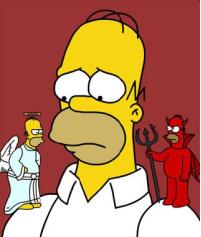 So a few weeks ago I was watching the morning news and their "Morning Buzz Question" was in regards to food stamps. One obviously Republican responder got to have his answer put up on the air in which he(?) made the remark that people on food stamps aren't supposed to be "feasting like Royalty." Yes, I'm quite sure the word "royalty" was even capitalized. The implication, if I must explain, is that people on food stamps are living the high life. This sounded remarkable like my coworker I ranted about last year. Not wanting to repeat essentially the same post again on how much a load of bullshit such a remark is, I was thinking of another way to tackle this type of thinking. The thought that came to me was that of the angel and devil on a person's shoulder trying to influence the actions of a person.
In this place I like to call reality, things don't seem to quite work this way. Rather than three parties involved, there are really only two, which involves the devil convincing the angel that a bad deed is actually for the better. These Republicans, it would seem, have their angelic side* that realizes it is wrong to not care about the poor. But their demonic side is concerned about #1. Need I say who #1 is? They don't want to have to dish out any money to take care of the poor. So they find "reasons" (read: excuses) for why their money not need be used to take care of the poor. In cases like this and in that earlier post, the "reason" is that the poor are doing just fine; better, even, then this probably middle-class Republican. Or at least that's the start of it. The other part is how they are doing compared to the amount of work they are thought to do. Because, though you can't tell from the comment here or in the previous post, there is a belief in conservative circles that people make money based on how hard they work. The harder you work, the more money you make. So if you're poor, you must be a lazy bum. Then if you're this lazy bum, you don't deserve to be "feasting like Royalty." The overall point is that these Republicans really have convinced themselves that they are people who care about the poor but it is the poor who are to blame for either not deserving care and/or receiving sufficient care as is. Never mind if these excuses are true or not, the important part is that the angelic side is satisfied.
And now for part two of this post. I was recently given more motivation for this post from a coworker based on a discussion regarding capital punishment. It was a bit funny listening to his demonic side convincing his angelic side capital punishment is for the best. His main target was mass murderers and the arguments that demonic side used included the idea that these murders don't feel anything when they commit their crimes and that the world has limited resources. First, how does he know what these criminals feel? Is he a mind reader? I won't argue that this could indeed be the case for some people, but maybe some of these murderers have come up with justifications for why their victims deserved to die, much like my coworker was justifying why these murderers could be put to death. As for the limited resources, could that also not be a reason to actually put those people back out on the streets? So that they may off a bunch more people who are using those precious resources? I'm totally not serious, but I thought it would help to demonstrate how that's really a non sequitur.
I see such rationalizing all over the place. Even the people who one would think are mean bigots are often nice people to those they aren't bigoted toward. They just have convinced themselves that their meanness is in the right, even if their reasoning is the highly delusional belief that their imaginary god friend also disapproves.
It also goes beyond mere moral questions. I have another coworker that I feel a bit sad for. She's rather religious and a while ago she told me that she wants to have good reasons for her faith. My first thought was that she would then no longer have faith because religious faith is all about believing without good reasons. My second thought, though, was that she is fooling herself. She's not really looking for good reasons, she's just convincing herself that she is. The result, I imagine, will be that she accepts bad reasoning thinking that it is actually good reasoning, much like she seems to think the "You aborted Beethoven" argument against abortion is a good argument when she doesn't even fully accept the argument herself. At the time, I gave her credit for at least recognizing that it is proper to have good reasons for one's beliefs. In hindsight, I probably should have pointed out that I also don't believe she'll actually follow through on her claim.
* It could also be that these people recognize that others see not caring for the poor is wrong and they are simply playing to their audience. I really don't find this likely.
It should be noted that what I am talking about here is one of the ways in which people deal with cognitive dissonance. This post, I think, focuses on the method where people "focus on more supportive beliefs that outweigh the dissonant belief or behavior." Sadly, as I discuss in this post, those "more supportive beliefs" are based on lies and people lying to themselves to the point where they believe their own lies.
Subscribe to:
Posts (Atom)